
 Good afternoon everyone!
Today's readings depict for us the story of Jacob's travels away from his homeland and to his uncle Laban's. So here are my thoughts for the day:
1) The dream at Bethel: Beth-el means "The House of God." Jacob calls it this because God revealed Himself to Jacob there. I'm reminded of the fact that this dream was primarily a way of reminding Jacob of what God is going to do for him and his family. But it is also a reminder that God does communicate with, and sometimes appear to and among His people, and their lives are changed because of their encounter.
Have you ever had a "Bethel" moment? Is there a "Bethel place" for you out there? For whatever reason, it seems that when God’s presence moves among people at a certain time or in a certain space, that time and place just stand out as sacred for us. They are life changing. They sustain us on our journey. And there is some sense in which that place or time becomes holy ground, which leaves us saying, “Surely the Lord is in this place and I knew it not.” Now granted, God is not only connected with certain spaces and times - but there are spaces and times which communicate to us, even long afterward, the awesomeness of God's presence in our lives, and the sureness of our faith in His existence and love.
2) The stairway to heaven - yes, it's literally a stairway. And no, the Bible didn't steal it from Led Zeppelin (that's a joke, by the way). It's interesting because Jesus makes a claim in the Gospel of John that they shall see the angels of God ascending and descending on the Son of Man - who is Jesus - and this is a reference back to the passage in Genesis 28. Jesus is the fulfillment of this prophecy, that all nations would be blessed through Jacob's descendants (Jesus is such a descendent). The interpretation of the passage in John is that Jesus is the bridge between heaven and earth - between God and humanity. Jesus reveals God's presence to us, and makes it available to us; likewise, he carries us to the heart of the Father. But, based on what Jacob has to say in response to this, and to Jesus' understanding later, the stairway communicates the ability to enter into the presence of God. And for Jacob, it was a sign that he was standing before the throne of the LORD Almighty and hearing the great promises of God to his descendants. Further, by being in the presence of God, Jacob's life was changed. The presence of God's power in our lives has the same impact - it changes us.
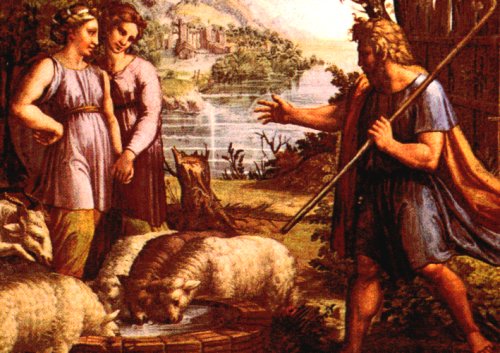
3) Jacob and Rachel: this story sets Jacob up as being almost as romantic as his father, until he kisses her and cries. haha. Sorry. Seriously, he was overcome by her beauty and the fact that he had found a person whom he truly loved. Anyway, when he goes back to Rachel's home with her, he promises to work seven years for Uncle Laban to gain her hand in marriage. He agrees, but then goes back on his promise, and tricks him to marrying Leah (which here seems equated with the act of sex - something to think about there). Leah has "weak eyes," which could mean she was blind, or unsightly, or even, as one rabbi put it, had cried so much that her eyelashes fell out because she didn't want to be married to Esau, which apparently the rabbi believes was pre-arranged (oldest of Laban for the oldest of Isaac; the youngest for the youngest). Whatever the case, she wasn't the one Jacob loved, but he was now "stuck" with her. But nevertheless, Jacob takes two wives (and I don't know why that's okay here and not elsewhere, but it is), and one's womb is opened; the other not. Then of course, he sleeps with their servants so that Rachel can have children (again I don't know why that's acceptable, but it is - and we saw how it worked out before). But finally, after eleven sons, the Lord God opens Rachel's womb and she gives birth to Joseph, who will be Jacob's prize child.
What do we learn from this? Well, we see what to avoid - treachery, having more than one sexual partner/wife, etc. Although these twelve tribes will give rise to the nation of Israel. Also interesting to note - Judah, the ancestor of Jesus, is the son of Jacob and Leah, not Jacob and Rachel. I find that really very interesting because the wife he truly loved was not the wife who would give rise to the promise of God. I don't know what bearing that has on us, but it's interesting.
And still... amidst the messiness of life, God is still working out His purposes. That's a life lesson to us if ever there was one. No one's life was ever what it should be, not even in the Bible. And yet God chooses to use the screwed up people of the world to accomplish His plans, and in the process makes them holy. The same is true for us - our lives can be pretty messed up, but God still uses us, God still transforms the messiness into good. And that's is the great hope and peace we find for our lives: God can still redeem us no matter how messed up we think our lives are.
That's a good note to end on... have a blessed evening!
In Christ,
Pastor Nathan

No comments:
Post a Comment