
Hi everyone,
Just wanted to say that I haven't stopped doing the readings or posting. I've just had a busy couple of days and lots of homework to do this afternoon before youth group. So... I'll try to post two days worth of readings before bed tonight.
In Christ,
Nathan
Sunday, January 31, 2010

Friday, January 29, 2010
Job 32:1-37:24
 Good evening all,
Yesterday and today, we have heard/are hearing the words of Elihu. Elihu hears the complaint of Job and he becomes angry because Job is attempting to justify himself before God, and because Job's friends are offering terrible advice. And so he pops into the story and we find a few interesting things to note here.
1) Scholars generally do not think this speech was originally part of the story, seeing as how the person doesn't really have interaction with the main characters. However, it has been tied into the flow of the story over time and has become accepted as a part of the canon; plus, it does provide another trajectory into the question of theodicy.
2) "But it is a spirit in man, And the breath of the Almighty gives them understanding." We Christians have a tendency to think it's up to us to make people understand or believe. But we see here that it is the breath of the Almighty (i.e. the Holy Spirit) who enables a person to do these things. Perhaps the greatest tool we Christians have, then, is to pray that the Holy Spirit will enable a person to find understanding and peace in the midst of difficult situations and doubt.
3) Elihu claims that he too has been in a similar position as Job: he is "righteous" and yet bad things befall him, too. Yet, when these things happen, Elihu claims that the Lord is working to vindicate him. Thus, there is an inconsistency in Job's argument: for while he criticizes God's indifference to human activity and questions his justice, Job still seeks vindication from God (which I take to mean that he seeks God to exonerate him or find him "not deserving" of this torment and restore him to his life).
4) Elihu also makes it clear that because God is God, and transcendent (wholly-other, bigger, more powerful, different from us), God's ways are not our ways and His purposes are not always discernible by humans. We cannot begin to grasp the ways of God. So to criticize God's ways is to show our lack of this basic understanding.
5) Elihu answers Job's complaint that God would not communicate with him - in fact, he mentions two ways in which God communicates with his people - through dreams and through illness/suffering. Job had already experienced terrifying dreams, as well as the suffering on his bed. C.S. Lewis once said in his book The Problem of Pain that pain is the "megaphone to rouse a deaf world." For Elihu, God's purpose in suffering is often redemptive - it is meant to bring back a person from "the pit," namely to bring them back from eternal death by forcing them to place their trust in God and receive "the light of life." Still, this is not the kind of communication from God that Job is looking for.
6) Then Elihu launches into his defense of God's justice. He asks how the God who is all powerful, who laid the foundations of the earth, whose breath is borrowed by humanity and still belongs to him, could possibly do wrong. Further, when Job asserts his righteousness and God's injustice, Elihu seems to indicate that Job thinks he is more knowledgeable about what is just than God is.
7) Job's hope for vindication: "But if men are bound in chains, held fast by cords of affliction, [God] tells them what they have done— that they have sinned arrogantly. He makes them listen to correction and commands them to repent of their evil. If they obey and serve him, they will spend the rest of their days in prosperity and their years in contentment. But if they do not listen, they will perish by the sword and die without knowledge."
8) "Listen to this, Job; stop and consider God's wonders." How often do we fail to meditate on God's handiwork in the creation around us. How often do we stop to marvel at the beauty of the flowers, the intricacies of the the trees, the flight of the bird or the cry of a wolf on a crisp winter night? Probably less than we should - but I think that truly when Christians can take time to appreciate the created order, we can catch a glimpse of God's goodness. Not only that, but it reminds us that the God who gave life to all these things and set them into motion, so cares for us that not even a hair can fall from our heads. If God cares that much, what makes us think that although we suffer and we don't understand, that God will not also deliver us through our suffering to a place where we are stronger and more mature?
9) In the end, Elihu seems to be saying that God is not punishing Job, but rather these trials are meant to build Job's faith in God, and to lead him to life. It is as if to say that suffering is a means of growth (Romans 8:28-30). But rather than patiently endure, Job would criticize God's justice and question God's ways. I think that it is fine for us to be upset at God when bad things befall us - it seems perfectly acceptable that we would express our emotions toward God. But we must also recognize that the God who created us, who set the world into motion and set the very definition of justice - whose breath is borrowed by us for our very life - that God is not mistreating us, but instead is using our suffering for a greater purpose.
It seems to me that the purpose of suffering here in Job, therefore, is to strengthen our faith in God and to draw us back to Him. It sounds strange, and perhaps unjust to our ears. But that just seems to be what this book is saying. Is it a complete view of suffering? Far from it - but it's one trajectory into the great abyss that is this problem.
On that note ... sermon writing awaits. Have a blessed evening! ... and please share thoughts/comments with me.
In Christ,
Pastor Nathan
Wednesday, January 27, 2010
Job 30-31:40

Good morning, everyone.
We continue today our walk through the book of Job. At this point, you are probably finding it a bit depressing... Job is struggling through his anger with God, while the friends continue to grow impatient with him. This is the end of Job's speeches, before the speech of Elihu to Job. I don't really have anything to point out from the reading that I have not already said in previous posts because it seems like the argument remains pretty much the same. So rather than repeat myself, I will simply let today's readings build up a certain level of desire for the resolution to the story, which we will continue to work toward.
Hope you have a great day!
In Christ,
Pastor Nathan
Tuesday, January 26, 2010
Job 22:1-29:25
Good morning, all:
Sorry about the delay in posting... yesterday was another busy day, and since I find these posts take me about an hour to write, I have to make sure I have ample time to offer my thoughts for the day. So, with my reading generally caught up for the moment, I thought I would take some time while in the quiet of the library to offer my throughts. So, here we go.
1) Eliphaz "the Impatient" Teminite speaks again to Job saying, in essence, "Listen Job, don't get all high and mighty on us. Admit to the fact that you've clearly sinned in your life because you, a rich man, haven't helped the needy. Now that's why God has struck you with these terrible problems. Don't act like you don't deserve it. And besides, you keep criticizing the God who still blesses you - don't you know that's exactly what led to the ruin of other evil persons."
Then he continues by saying that, "Job, why not just make peace with God and you will receive blessing upon blessing. He will hear your prayers and your life will be merry sunshine all the time." Sadly, so many people think God works this way, but he doesn't. God is not some cosmic vending-machine who simply gives us what we want so long as we put in the right change. That would make God manipulatable by us, and it would also leave no room for His grace and His love, because it makes our salvation basically up to us.
2) Job doesn't seem to acknowledge Eliphaz; he just states again that he wants the chance to argue this with God. Interestingly enough, Job says in vv. 8-9, "But if I go to the east, he is not there; if I go to the west, I do not find him. When he is at work in the north, I do not see him; when he turns to the south, I catch no glimpse of him." Compare that with Psalm 139:7-8, "Where can I go from your Spirit? Where can I flee from your presence? If I go up to the heavens, you are there; if I make my bed in the depths, you are there." Clearly, Job's are the words of one who struggles to find God's presence; yet the words of the Psalmist reflect the reality that we cannot escape from God. Even in the darkest moments of our lives, when God seems absent, He is with us. He may be silent, but he is with us. Why that is, we do not know.
3) Job also states that "When God has tried me, I will come forth as gold." Although he is angry with God, and He feels God is being a tad tyrannical (see v. 13), Job seems to indicate a hope that when he emerges from this time of suffering, he will indeed be "refined" as fire through gold - which would seem to indicate that through the fire of these torments, God will transform his life. In the midst of our suffering, this can indeed be our only hope. Job is also afraid of God. He fears God's power. But that doesn't stop him from launching his accusation against what he sees as God's injustice.
4) Job then asks why the unrighteous are not judged by God. They go around harming others and committing all sorts of evil and shameless acts, and yet their judgment never comes. Why does God delay this judgment? God alone knows. But Job rests assured that the grave gets them in the end, and they are forgotten. And God sees what they do, and he drags them away from their power, leaving them with no assurance for life.
5) Then Bildad reasserts that God is the one who ordains order in the world, and the one who set the forces into motion. God is, essentially, the plumb line by which all standards are both measured and set. Thus, how can man be pure before God if they are but maggots before him? Seems to me Bildad had an understanding of the "Total Depravity" of man - that is, that humans are not good by nature, but fundamentally bad. Good Calvinist,he was.
6) Job gets a tad sarcastic and cynical, saying in essence, "Oh, that's so helpful for people like me in anguish. THANK YOU for your excellent message of hope!" Then he says, "God has wronged me - He has denied me justice. I don't care if that's the way it is. I will not submit to your estimation of the way things are - I am not a horrid sinner, I've done everything God wants me to do, [and to quote Ned Flanders from the Simpsons for comedic relief] 'including the stuff that contradicts the other stuff.' I've done everything right! And I will continue to be righteous and never open my mouth in sinfulness agaisnt God." Then job goes on to describe the fate of the wicked and the lament of the vanity of human existence. He says, "How I long for the days when God blessed me and my hand. Oh for those days when in my power, I helped the poor and the fatherless. I wish I could go back in time.
Well, that's all for today. We continue to struggle with Job. Maybe I'll add a little more insight later when I have some more time. Have a blessed day!
In Christ,
Pastor Nathan
Sorry about the delay in posting... yesterday was another busy day, and since I find these posts take me about an hour to write, I have to make sure I have ample time to offer my thoughts for the day. So, with my reading generally caught up for the moment, I thought I would take some time while in the quiet of the library to offer my throughts. So, here we go.
1) Eliphaz "the Impatient" Teminite speaks again to Job saying, in essence, "Listen Job, don't get all high and mighty on us. Admit to the fact that you've clearly sinned in your life because you, a rich man, haven't helped the needy. Now that's why God has struck you with these terrible problems. Don't act like you don't deserve it. And besides, you keep criticizing the God who still blesses you - don't you know that's exactly what led to the ruin of other evil persons."
Then he continues by saying that, "Job, why not just make peace with God and you will receive blessing upon blessing. He will hear your prayers and your life will be merry sunshine all the time." Sadly, so many people think God works this way, but he doesn't. God is not some cosmic vending-machine who simply gives us what we want so long as we put in the right change. That would make God manipulatable by us, and it would also leave no room for His grace and His love, because it makes our salvation basically up to us.
2) Job doesn't seem to acknowledge Eliphaz; he just states again that he wants the chance to argue this with God. Interestingly enough, Job says in vv. 8-9, "But if I go to the east, he is not there; if I go to the west, I do not find him. When he is at work in the north, I do not see him; when he turns to the south, I catch no glimpse of him." Compare that with Psalm 139:7-8, "Where can I go from your Spirit? Where can I flee from your presence? If I go up to the heavens, you are there; if I make my bed in the depths, you are there." Clearly, Job's are the words of one who struggles to find God's presence; yet the words of the Psalmist reflect the reality that we cannot escape from God. Even in the darkest moments of our lives, when God seems absent, He is with us. He may be silent, but he is with us. Why that is, we do not know.
3) Job also states that "When God has tried me, I will come forth as gold." Although he is angry with God, and He feels God is being a tad tyrannical (see v. 13), Job seems to indicate a hope that when he emerges from this time of suffering, he will indeed be "refined" as fire through gold - which would seem to indicate that through the fire of these torments, God will transform his life. In the midst of our suffering, this can indeed be our only hope. Job is also afraid of God. He fears God's power. But that doesn't stop him from launching his accusation against what he sees as God's injustice.
4) Job then asks why the unrighteous are not judged by God. They go around harming others and committing all sorts of evil and shameless acts, and yet their judgment never comes. Why does God delay this judgment? God alone knows. But Job rests assured that the grave gets them in the end, and they are forgotten. And God sees what they do, and he drags them away from their power, leaving them with no assurance for life.
5) Then Bildad reasserts that God is the one who ordains order in the world, and the one who set the forces into motion. God is, essentially, the plumb line by which all standards are both measured and set. Thus, how can man be pure before God if they are but maggots before him? Seems to me Bildad had an understanding of the "Total Depravity" of man - that is, that humans are not good by nature, but fundamentally bad. Good Calvinist,he was.
6) Job gets a tad sarcastic and cynical, saying in essence, "Oh, that's so helpful for people like me in anguish. THANK YOU for your excellent message of hope!" Then he says, "God has wronged me - He has denied me justice. I don't care if that's the way it is. I will not submit to your estimation of the way things are - I am not a horrid sinner, I've done everything God wants me to do, [and to quote Ned Flanders from the Simpsons for comedic relief] 'including the stuff that contradicts the other stuff.' I've done everything right! And I will continue to be righteous and never open my mouth in sinfulness agaisnt God." Then job goes on to describe the fate of the wicked and the lament of the vanity of human existence. He says, "How I long for the days when God blessed me and my hand. Oh for those days when in my power, I helped the poor and the fatherless. I wish I could go back in time.
Well, that's all for today. We continue to struggle with Job. Maybe I'll add a little more insight later when I have some more time. Have a blessed day!
In Christ,
Pastor Nathan
Sunday, January 24, 2010
Job 15-21:34
Hi everyone!
Sorry for the delay in posting again. Anyway, here are the thoughts for today
1) Round two of the speeches begins. Eliphaz runs out of patience and tells Job he is full of hot air, and what he is saying is irreverent and deceitful. Eliphaz accuses Job of being prideful and arrogant, ignorant of the sinfulness of human beings. Yet God has consoled him and spoken kindly to him. He also refuses to believe, as Job claims, that the wicked prosper; for in the end, they always get their just desserts. But Epiphaz's understanding of God is one who could not possibly be loving or kind - instead God seems to be a mechanistic God who simply blesses those who do good, while punishing those who do bad. He goes on to even mention everything that happened to Job. He makes it clear - Job is a sinner who got what he deserved. Wow.
2) Job fires back. And again he continues he argument against God. He pleads for a mediator who would plead with God as a man pleads with his neighbor. This is interesting, as the Jesus Christ will later come and now functions as such a mediator between God and man.
3) Sheol - by the way, Sheol refers to the realm of the dead, almost like the Greek Hades. It's the destination of both the wicked and the righteous in Hebrew understanding.
4) Bildad then accuses Job of being too self-absorbed, thinking that he could whine in vain to make the creator change the divine ordering. He also accuses Job of misunderstanding God's divine retribution. In then end, Bildad rests assured that the wicked will receive their just rewards.
5) Job lets the men know that he has been insulted, and that whatever they may say, God appears to be against him. He again complains that everyone, including God, is against him. And he insists that his friends should at least be a source of comfort and not of torment. They have "devoured his flesh" (an idiom for slandering).
6) Job 19:23-27 is a passage I often read at funerals. Job has hit an all time low point, especially in light of Bildad's comment that Job will simply die and be forgotten (18:17). So Job, calling for the words to be permanently inscribed, and staring into the face of his impending death, Job looks to a future Redeemer who will finally some day vindicate him. It seems that this vindicator would be the same God who is "tormenting" him, and that one day, Job believes he will be raised to stand before him and God will declare him to be in a right standing.
7) Then Zophar again speaks a poem about the demise of the wicked. What he says here has some truth in it, the problem lies in the fact that Zophar puts too much stress on material possessions as a sign of God's favor, when Job is only concerned about his relationship to God and could care less about what happened to his body of his possessions.
8) Job's final rebuttal of the night: He basically tells them that this is not the way things are. The wicked still prosper while the righteous suffer. Why is this? How is this fair? What is wrong with God if he allows this? Job declares that their answers are false and nonsensical.
That's happy reading, isn't it? Well, I think that our readings are drawing us more deeply into the problem of theodicy (God's justice in the face of suffering), and forcing us to think more deeply as we traverse through this book.
Well, I think that's all for tonight. Have a great evening!
In Christ,
Pastor Nathan
Sorry for the delay in posting again. Anyway, here are the thoughts for today
1) Round two of the speeches begins. Eliphaz runs out of patience and tells Job he is full of hot air, and what he is saying is irreverent and deceitful. Eliphaz accuses Job of being prideful and arrogant, ignorant of the sinfulness of human beings. Yet God has consoled him and spoken kindly to him. He also refuses to believe, as Job claims, that the wicked prosper; for in the end, they always get their just desserts. But Epiphaz's understanding of God is one who could not possibly be loving or kind - instead God seems to be a mechanistic God who simply blesses those who do good, while punishing those who do bad. He goes on to even mention everything that happened to Job. He makes it clear - Job is a sinner who got what he deserved. Wow.
2) Job fires back. And again he continues he argument against God. He pleads for a mediator who would plead with God as a man pleads with his neighbor. This is interesting, as the Jesus Christ will later come and now functions as such a mediator between God and man.
3) Sheol - by the way, Sheol refers to the realm of the dead, almost like the Greek Hades. It's the destination of both the wicked and the righteous in Hebrew understanding.
4) Bildad then accuses Job of being too self-absorbed, thinking that he could whine in vain to make the creator change the divine ordering. He also accuses Job of misunderstanding God's divine retribution. In then end, Bildad rests assured that the wicked will receive their just rewards.
5) Job lets the men know that he has been insulted, and that whatever they may say, God appears to be against him. He again complains that everyone, including God, is against him. And he insists that his friends should at least be a source of comfort and not of torment. They have "devoured his flesh" (an idiom for slandering).
6) Job 19:23-27 is a passage I often read at funerals. Job has hit an all time low point, especially in light of Bildad's comment that Job will simply die and be forgotten (18:17). So Job, calling for the words to be permanently inscribed, and staring into the face of his impending death, Job looks to a future Redeemer who will finally some day vindicate him. It seems that this vindicator would be the same God who is "tormenting" him, and that one day, Job believes he will be raised to stand before him and God will declare him to be in a right standing.
7) Then Zophar again speaks a poem about the demise of the wicked. What he says here has some truth in it, the problem lies in the fact that Zophar puts too much stress on material possessions as a sign of God's favor, when Job is only concerned about his relationship to God and could care less about what happened to his body of his possessions.
8) Job's final rebuttal of the night: He basically tells them that this is not the way things are. The wicked still prosper while the righteous suffer. Why is this? How is this fair? What is wrong with God if he allows this? Job declares that their answers are false and nonsensical.
That's happy reading, isn't it? Well, I think that our readings are drawing us more deeply into the problem of theodicy (God's justice in the face of suffering), and forcing us to think more deeply as we traverse through this book.
Well, I think that's all for tonight. Have a great evening!
In Christ,
Pastor Nathan
Friday, January 22, 2010
Thursday, January 21, 2010
Job 5:1-11:20 - Double Feature

Good evening all!
I figured that while I had a little down time, I would go through today's readings with you (as well as yesterdays) to give some insights on what we're reading). So here we go:
1) First, remember Job's outburst from yesterday? Well, the more I read, I learned that if you look carefully, he all but cursed God (for instance, he wished he'd never been born, questioning God's hand in creating him; he wished the daylight would disappear into darkness, whereas light is a sign of God's glory, etc.).
2) So, with that in mind, we notice the friends are reacting to Job's statements. What these friends say to Job doesn't sound too far off the mark theologically; yet, the text wants us to realize that there is something wrong with what they are telling Job - thus, we've got to work harder to find out what they do and say that is wrong (because it doesn't appear so plainly here).
3) Eliphaz could be saying one of two things in his speech from 4:1-5:27. He may be saying that because of Job's sin, these calamities befell him (which is a misapplication of the truths he cites), or he may be saying that because human sin generally exists, these calamities and works of evil exist in the world, which would be true. But Eliphaz claims that Job has acted foolishly, and therefore we see how a transcendent God (who is all powerful, bigger than and apart from the world) reacts toward such foolishness. Then Eliphaz connects these calamities with God's discipline, but offers hope the righteous - that he/she will always be delivered by God. "For He inflicts pain, and gives relief; He wounds, and His hands also heal." The very God who injured Job and his family is the same God who will also restore his fortunes and his life. But as Smick points out, "In the light... of Job's experiences...there is a thoughtless cruelty inherent in applying the words of v. 19-26 to him." For instance, while Eliphaz says that if Job benefits from God's discipline, his children would be many; however, his children are dead. Perhaps the truth in all this, then is that although Eliphaz knows his "theology" (his understanding of God), he doesn't have a clue about what God's divine purpose in all these things really is. His words do nothing to help Job deal with his grief. So in the end, sometimes even the smartest among us can miss the point. And when we are counseling those who grieve, we must be careful not to use pious cliches or empty theologizing to help a person "get over it." We do very little to help the person. Even though the disciplining nature of suffering might be worth contemplating when one suffers, this is not revealed to be the purpose of the case at hand.
4) Job now begins two chapters worth of attacks, first against the counselors, and then against God. His words, however, come from his limited knowledge of God's greater plan and Job's determination to speak the truth as he sees it. He views God in these chapters as the one who caused this anguish and misery to befall him, as if God were shooting arrows at him. To him, death would have been a great relief because he felt so burdened by what was happening to him. Not only does Job take God to task, but he also argues against those who were trying to console him, saying that their words were bad medicine, they were undependable, cruel, and viewed him as unworthy of their help.
5) Then Bildad, friend #2, begins to speak. Job has just plead for compassion and kindness from them, and Bildad, though he heard Job's words, they had no impact on him. Instead, he is a total jerk. He tells Job that his sons got exactly what they deserved for their wild living and that Job was on his way to the same fate. Further, there is a tone of arrogance to what he has to say. Interestingly, Smick says, "No doubt a large part of the problem was their academic commitment to a viewpoint they refused to alter, namely, that sin brings suffering and suffering is evidence of sin" (906). In short, Bildad models for us a clear model of how we should not counsel those who grieve - namely, that we should listen to what the person has to say, to become involved, to have respect for their integrity, and never forget that we may not fully understand the mystery of what God is doing in the situation. We should not attempt to pin the blame for the calamity on the person's behavior - no matter how tempting that might be, because that's not necessarily the reason the calamity befell them.
6) Job answers Bildad by saying, "Clearly you're missing the point." It's obvious to Job that the problem lies in human inability to be righteous. And God knows this. The problem, as Job sees it, is that he cannot even dispute his case before God. God, in his infinite wisdom and power, says Job, is almost like a great tyrant who does whatever he wants with no regard for the people he is lording over. Job wishes that there were a mediator, one who could plead his case before God. He truly believes that God is unjust in his dealings; even though Job contends that he himself is righteous, God would condemn him for what he says, and though Job is guiltless, God will declare him guilty. "It's not fair," says Job, "I hate my life." In fact, he might go a step further than that. There's a not-so-nice acronym that gets used in our world of text-messaging that I think, if Job lived today, would probably use at this point. No, Job says, "I could try and 'put my problems in a bubble and blow them away,' but what good would it do? I'm still wicked before God - why not just be miserable anyway? He is not a human that I could take him to court. There is no mediator, no umpire , no attorney, who will mediate for me, no one to plead my case. Oh, I wish he'd just stop this craziness!"
Job continues: "I HATE my life. I am very bitter in the depths of my soul. God, are you in any way capable of understanding what it means to be human? Can you understand what you are doing from my point of view? Are you like the human sinner that goes around seeking my demise? How can you be so unjust that you would do this to me?
7) Then Zophar, friend #3 steps in. He ridicules Job and criticizes him for saying what he did. "How dare you think that you're a good person. You're a sinner like everyone else! And who are you to question God - if you can't even fathom the immensity of the cosmos, what makes you think you could begin to understand what God is doing? The only thing you should do at this point is repent, and then your life will be happy and carefree again, and nothing bad will harm you!" Except that Job really is a righteous person, and bad things still happened to him. Apparently, Zophar wasn't paying attention to Job either. The man is pouring out his heart and soul, and the anger and bitterness he feels toward God, who seems to be unjust to him. And all these crummy friends want to do is throw pious cliches at him, or chastise him for questioning God, or make his predicament seem unworthy of such anger.
Clearly, these friends do not understand their role at this point. But what I want to point out here is not so much their failure to listen, but what we hear Job saying when we listen to him. Go back and look over that again. What you will hear are the same statements and cries that so many people who feel abandoned and hurt by God have to say about Him. The more we read this, the more we can fully understand and take in the depth of Job's emotion. Perhaps we can even relate to it. And when we do, this will help us learn more of what God is saying to us through the book.
Wow. Now I'm caught up. That took me three hours off and on to write, but it's done. May God bless you and grant you a peaceful rest.
In Christ,
Pastor Nathan
Oops...
 Good morning, all:
So I thought I'd update twice yesterday, but I was up late working on things for a funeral and never got to it. So perhaps today or tomorrow I'll do a double post and get caught up. I'll be posting later in the day today as well.
In Christ,
Pastor Nathan
Wednesday, January 20, 2010
Job 1:1-4:21 - Attempt Number 2

Good morning, all!
After a good night's rest, I'm ready to tackle the passage, so here we go.
1) I had to share this statement from a commentary by Elmer B. Smick which helps capture the essence of the book. He says, "The Prologue introduces us to Job as a man of faith and shows how his fortunes on earth were directed by heavenly forces beyond his control. But its full purpose lies even deeper... With this prologue, the purpose of the book is clarified - to show that in a world where evil is a reality, good people may appear to unjustly suffer, but that such injustice is precipitated by the Accuser and, though permitted by God, it is an expression of God's total confidence that the faith of his servant will triumph" (Job, The Expositors Bible Commentary, Zondervan, 1988. pp. 878).
2) Again, Job is considered to be blameless and upright. He even goes out to sacrifice for his children to protect them after they had great parties. Sounds like a devoted father and a very righteous man.
3) Then the scene cuts away to the spiritual realm, where the "sons of God" (supernatural beings that are below God but above humans, and possibly angels) come before the throne of God. Then enters hassatan, the Accuser, or as we've come to call him "Satan." (Cue the church lady from SNL "Could it be, SATAN?!?!"). If my understanding is correct, Judaism does not understand Satan as the enemy of God, but rather as "the Satan" or "the Adversary" who works for God and apparently makes the decision to choose good over evil difficult. That seems to be the understanding that is put forth in Job . What we know understand as the Christian concept of Satan developed over some time and, by the close of the New Testament, Satan was now understood as God's enemy. Here, however, we must be true to the original understanding and see Satan as the Accuser, the one who is not to destroy but only test/challenge humans before God.
 4) Great calamity befalls Job at the hand of the Accuser. I alone have escaped to tell you. A random story: Many of you may remember back in May of 1985, there was a large tornado outbreak in Eastern Ohio and Western Pennsylvania. For those unfamiliar, the rarity of this event makes it quite memorable and it is now embedded as a part of our local cultural story. Anyway, I'm told that when one of the tornadoes took the roof off of a church in Western PA, the pastor later entered the wrecked church to find that the Bible on the Altar was opened to Job, chapter 1, and this was the passage that caught his attention on the page: "Your sons and your daughters were eating and drinking wine in their oldest brother's house, and behold, a great wind came from across the wilderness and struck the four corners of the house, and it fell on the young people and they died, and I alone have escaped to tell you.". Creepy. But the point is that Job looses everything here: his oxen were stolen, fire came down from heaven and consumed the sheep, his servants were killed and their camels stolen, and worst of all - a great wind (possibly a tornado) swept away the house in which his children were partying. It was as if everything was taken from him. "And I alone have escaped to tell thee."
5) Job begins to mourn. Yet he says, "'The LORD gave and the LORD has taken away. Blessed be the name of the LORD.' Through all this Job did not sin nor did he blame God." I think we are probably first tempted to start asking God "Why?" And yet Job's first thing is to simply bless God. He may have been angry with God, He may have been upset that it happened (and we will find that this is the case in the near future), but He never rejects God. What a very hard thing to do in the face of calamity. And yet, by doing this, Job blesses and does not curse God - and the work of the Adversary is foiled.
6) Then it gets worse: The Adversary goes to work again. He smote Job with boils. Job's wife says, "Haven't you had enough. Why not just curse God and die already!" But then Job does a funny thing and says, "You talk like a foolish woman. What, should we only accept good from God and not accept adversity?" Some people would say yes, but Job says no: and it seems that there is a depth of understanding here upon which we must meditate. If we were in Job's shoes, what would we do? Would we curse God and die, or would we bless Him? What is the model of Job? Is it the correct model? Again, don't think Job doesn't get angry with God or upset with him - we spend most of the book wrestling with his comments and complaints against God. It's just that he doesn't reject God.
7) The three friends. They come to mourn with Job, to sympathize with him and to comfort him. They go through the typical ritual of mourning and do not even speak to him for seven days. Finally, Job lets out a song of lament and mourning. It's pretty moving poetry here, and any who have undergone some kind of suffering or hardship in their lives can relate to these emotions and sentiments.
8) Then the friends try to comfort Job. DISCLAIMER: the following several chapters are an example of what not to say to people who suffer in their lives because they lack an understanding of the bigger picture.
9) However, Eliphaz the Teminite has some interesting things to say here. "Behold you have admonished many, And you have strengthened weak hands. "Your words have helped the tottering to stand, And you have strengthened feeble knees. "But now it has come to you, and you are impatient; It touches you, and you are dismayed. Is not your fear of God your confidence, and the integrity of your ways your hope?" It's like the time I was told, "I thought you were a Christian - you aren't supposed to complain or be upset." Although the complaining part could be correct, what is implicit in this is that true followers of God should basically act like they've had a frontal lobotomy. Eliphaz says, "You've encouraged so many others in the mourning; and yet here you are whining and complaining. Isn't your hope in God." I just want to scream "You moron! What, is he not allowed to express emotions or grief?" Am I allowed to say that to a biblical character? I will anyway.
10) He goes on to start then talking about human sinfulness. I know where he's going with this, and he's going to come to a pretty idiotic conclusion, but we'll get there later in the day. One statement that jumped out at me was: "Can mankind be just before God? Can a man be pure before his Maker?" It seems to me the implied answer is no, not on his/her own merit. Or, from this perspective, even if he/she can, it is quite difficult. Either way, this part of the statement is a real downer, a very stoic, unfeeling, sense of doom and gloom for all humanity.
Well, on that wonderful note, I hope you all have a great and blessed day. The peace of the Lord Jesus be with you!
In Him,
Pastor Nathan
Tuesday, January 19, 2010
Job 1:1-4:21 - my first attempt
Good evening folks,
Gosh, it gets later by the minute! Well, let's see if I can complete this by midnight.
So here we are: we've finished Genesis and we move on to... Job. Yes, that's where we're going next since we're reading the Bible chronologically. So let me give you some background and we'll jump into this great read. Now, some brief notes about the book itself:
1) No one is really sure who wrote it.
2) Although the One Year Bible people have suggested that this book comes next in order, no one knows for sure when it was actually written. The big thing has to do with how developed the theology of this book is, in comparison to the theological competency that Israel would have had in that time and place.
So much for that... But what I can tell you is that the book of Job is a work of poetry, a part of the Hebrew Tanak/Scriptures called the Kethuvim, which includes eleven books: The poetic books are Psalms, Proverbs and Job; the five scrolls are Ecclesiastes, Song of Solomon, Ruth, Lamentations, and Esther; and the other historical books of Ezra-Nehemiah, Daniel and 1/2 Chronicles). The book of Job seeks to deal with the question that I hear so much as a pastor, "Why do bad things happen to good people? Is God punishing people when bad stuff happens to them?" and the like. There will be much we can learn as we explore this text that will aid us in exploring the question - even though I don't know what the answer to it actually is.
Well, I need to devote time and energy to this that I do not currently have... it's been a long day. So I'll get to my thoughts on the passage in the morning. Until then, the peace of Christ be with you.
In Him,
Pastor Nathan
Gosh, it gets later by the minute! Well, let's see if I can complete this by midnight.
So here we are: we've finished Genesis and we move on to... Job. Yes, that's where we're going next since we're reading the Bible chronologically. So let me give you some background and we'll jump into this great read. Now, some brief notes about the book itself:
1) No one is really sure who wrote it.
2) Although the One Year Bible people have suggested that this book comes next in order, no one knows for sure when it was actually written. The big thing has to do with how developed the theology of this book is, in comparison to the theological competency that Israel would have had in that time and place.
So much for that... But what I can tell you is that the book of Job is a work of poetry, a part of the Hebrew Tanak/Scriptures called the Kethuvim, which includes eleven books: The poetic books are Psalms, Proverbs and Job; the five scrolls are Ecclesiastes, Song of Solomon, Ruth, Lamentations, and Esther; and the other historical books of Ezra-Nehemiah, Daniel and 1/2 Chronicles). The book of Job seeks to deal with the question that I hear so much as a pastor, "Why do bad things happen to good people? Is God punishing people when bad stuff happens to them?" and the like. There will be much we can learn as we explore this text that will aid us in exploring the question - even though I don't know what the answer to it actually is.
Well, I need to devote time and energy to this that I do not currently have... it's been a long day. So I'll get to my thoughts on the passage in the morning. Until then, the peace of Christ be with you.
In Him,
Pastor Nathan
Monday, January 18, 2010
Genesis 47:28-50:26
Good morning everyone, and a Happy Martin Luther King Day to you.
Today we finish the book of Genesis. Here are some thoughts on the readings:
1) Notice, after having been told in several vision the promise of God, Jacob takes comfort in this upon his deathbed and reiterates it to his children. He never forgets God's promises, but even in death, passes the promise on. So also we, who have received the promise of God upon our own lives, should even in death desire to pass those promises on to our children.
2) Who or what is Shiloh? (49:9-12) Scholars disagree on who or what this actually is. Some take it to mean "until he (Judah) comes up to Shiloh." Some Christians and many Jews have also applied this to Messianic prophecy (that is, referring to the Messiah, whom Christians believe to be Jesus Christ), and I think it does make sense if Shiloh is meant to be a personal name.
3) Jacob was "Gathered to his people" I just really like how this is stated. I think it does perhaps give us hope of being reunited with loved ones who now stand before the throne of Jesus. I wouldn't build a whole theology around it (and I haven't done any real research on this), but I do like the way this is stated.
4) Do not be afraid, for am I in God's place? As for you, you meant evil against me, but God meant it for good in order to bring about this present result, to preserve many people alive. Again, reminds us of the promise in Romans 8:28, "God works for the good of those who love Him and are called according to His purpose." Whatever bad befalls us in life, will not God ultimately use it for good and according to His purpose? That is certainly our hope.
Well, I think that's all for today. Tomorrow, we begin our journey through the book of Job. Blessings to you today!
In Christ Jesus,
Pastor Nathan
Today we finish the book of Genesis. Here are some thoughts on the readings:
1) Notice, after having been told in several vision the promise of God, Jacob takes comfort in this upon his deathbed and reiterates it to his children. He never forgets God's promises, but even in death, passes the promise on. So also we, who have received the promise of God upon our own lives, should even in death desire to pass those promises on to our children.
2) Who or what is Shiloh? (49:9-12) Scholars disagree on who or what this actually is. Some take it to mean "until he (Judah) comes up to Shiloh." Some Christians and many Jews have also applied this to Messianic prophecy (that is, referring to the Messiah, whom Christians believe to be Jesus Christ), and I think it does make sense if Shiloh is meant to be a personal name.
3) Jacob was "Gathered to his people" I just really like how this is stated. I think it does perhaps give us hope of being reunited with loved ones who now stand before the throne of Jesus. I wouldn't build a whole theology around it (and I haven't done any real research on this), but I do like the way this is stated.
4) Do not be afraid, for am I in God's place? As for you, you meant evil against me, but God meant it for good in order to bring about this present result, to preserve many people alive. Again, reminds us of the promise in Romans 8:28, "God works for the good of those who love Him and are called according to His purpose." Whatever bad befalls us in life, will not God ultimately use it for good and according to His purpose? That is certainly our hope.
Well, I think that's all for today. Tomorrow, we begin our journey through the book of Job. Blessings to you today!
In Christ Jesus,
Pastor Nathan
Sunday, January 17, 2010
Genesis 45:16-47:27
Good evening everyone,
We are getting closer to the end of the book of Genesis. Here are today's thoughts:
"I am God, the God of your father; do not be afraid to go down to Egypt, for I will make you a great nation there. I will go down with you to Egypt, and I will also surely bring you up again." When God speaks this to Jacob (called Israel here), we see again God appearing to Him in a dream. Again, God reiterates the promise He made to Jacob's fathers, and has repeated throughout Jacob's life. And indeed, God goes with them all to Egypt, and they do become prosperous in the land.
I just was thinking about the concept of God going with them. No matter where Israel goes, God is with him/them. God is not a God who is confined to a sacred space, but who is wherever His people are. I think that's important for us to remember today because so often we forget that God is with us in the person of Jesus and by the power of the Holy Spirit. In fact, that's what the name "Emmanuel" means.
What a great comfort to know that wherever we roam in this world, our Lord neither leaves nor forsakes us. Since God is with us wherever we are, we need not fear, for we are safe in His arms. Further, because we belong to Him, he will indeed lead us to the promised inheritance of eternal life which is ours in Jesus Christ.
Well, I don't have much else to say, but I think what little I said is a great deal to ponder and meditate on. Have a blessed evening.
In Christ Jesus,
Pastor Nathan
We are getting closer to the end of the book of Genesis. Here are today's thoughts:
"I am God, the God of your father; do not be afraid to go down to Egypt, for I will make you a great nation there. I will go down with you to Egypt, and I will also surely bring you up again." When God speaks this to Jacob (called Israel here), we see again God appearing to Him in a dream. Again, God reiterates the promise He made to Jacob's fathers, and has repeated throughout Jacob's life. And indeed, God goes with them all to Egypt, and they do become prosperous in the land.
I just was thinking about the concept of God going with them. No matter where Israel goes, God is with him/them. God is not a God who is confined to a sacred space, but who is wherever His people are. I think that's important for us to remember today because so often we forget that God is with us in the person of Jesus and by the power of the Holy Spirit. In fact, that's what the name "Emmanuel" means.
What a great comfort to know that wherever we roam in this world, our Lord neither leaves nor forsakes us. Since God is with us wherever we are, we need not fear, for we are safe in His arms. Further, because we belong to Him, he will indeed lead us to the promised inheritance of eternal life which is ours in Jesus Christ.
Well, I don't have much else to say, but I think what little I said is a great deal to ponder and meditate on. Have a blessed evening.
In Christ Jesus,
Pastor Nathan
Saturday, January 16, 2010
Genesis 42-45:15
Good evening, all! Here are today's thoughts.
1) "What is this that God has done to us?" Sometimes, God doesn't make a lot of sense. Normally, you would not bless those who do wrong to you or who go against you; and yet, God often continues to pour out His love on unfaithful people. Why?
This is the question of Joseph's brothers after their dealings in Egypt - what did they do to deserve the gifts they've received in Egypt? This is especially true as they think about what they did to their brother Joseph, whom they believe is dead at the beginning of the passage. Yet, even in the face of their treachery, envy and sin, God takes an otherwise bad situation and uses it to redeem and save His children - He saves those who do not deserve it.
None of the gifts we receive from hand of God are based on anything we do. God instead chooses to lavish the blessings he does upon His children precisely because He loves us, and longs to work through us. When Jesus came to the earth to live for us, to die for us, to rise again for us, and to ascend for us, He came as an undeserved gift from the Father to save and redeem God's children. In Him, God lavishes upon His children new life, a renewed relationship with the Father, the adoption as sons of God, and all the other blessings in Jesus. Further, God gives us these gifts because He longs for us to use them in a way that glorifies Him and shares His loving-kindness with others in the world.
So why does God bless us like He does? Because He loves us. And in response to His love, God desires that we use His gifts to bless others and share that love with them. The problem is that we often become greedy with our gifts, rather than using those gifts to bless and to help others in the Name of Jesus Christ. We hoard our wealth, and squander our gifts. We are hesitant to share with others, and refuse to give anything to those who wrong us. We meditate on the Good News of Jesus without considering those in our lives who need to hear it most. We still don't deserve it, but God still gives these to us anyway.
This is a reminder for us of God's amazing love expressed in Jesus Christ and in the power of the Holy Spirit. Even when we don't deserve His love, God still remains faithful to His promises and therefore to us. God still lavishes His love and mercy upon us.
2) "God sent me before you to preserve life... God sent me before you to preserve for you a remnant in the earth, and to keep you alive by a great deliverance. Now, therefore, it was not you who sent me here, but God..." You know, we can't always control what happens in our lives - often, what truly causes a disaster in our lives is when we face a challenge we cannot control. Cancer. Debt. Unemployment. Death. All of these are realities we cannot control. And when we face these, we begin to ask "Why?" Why did God allow this to happen? Why me? What did I do wrong?
That's why Joseph's perspective is hard for us to understand. We don't like it when people point to their sufferings and say, "God made this happen so that..." But isn't that the message of this passage? God took what the brothers intended for evil and brought good out of it? Perhaps God even intended for something to happen in the midst of all this that would correct the evil and injustice? Now, that's not to say that God desires that evil befall us or that God causes evil to befall us for His own purposes - that would make God very unjust and selfish. But what it does say is that even in the face of injustice or unspeakable tragedy, God is working to bring some good out of it; to take what is otherwise bad, and working to bring something good out from it.
In light of the recent events in Haiti, people are wondering why this happened. We cannot begin to understand why or to wrap our minds around it, except to say that this is a sign that the world groans in pain because of our sin and the evil it brought into the world. But instead of asking ourselves "Why?," we could be looking for the good God is bringing out of all this. We could be agents of the good God is bringing out of this. And it seems to me that's just what God always does: He brings the good out of the bad. It's not always plainly visible; often times it is hidden deep within the hurts and brokenness of our lives. But only through suffering do we truly learn and grow - and only through suffering do we inherit God's eternal love and life.
So we must trust that even in our lowest moments, when life does not go as we planned and everything is falling apart, God is working for the good. Somehow, someway. Because that's what He promises He will do, and that's a promise He has never failed upon.
Well, that's all for now. God bless!
In Jesus Christ,
Pastor Nathan
1) "What is this that God has done to us?" Sometimes, God doesn't make a lot of sense. Normally, you would not bless those who do wrong to you or who go against you; and yet, God often continues to pour out His love on unfaithful people. Why?
This is the question of Joseph's brothers after their dealings in Egypt - what did they do to deserve the gifts they've received in Egypt? This is especially true as they think about what they did to their brother Joseph, whom they believe is dead at the beginning of the passage. Yet, even in the face of their treachery, envy and sin, God takes an otherwise bad situation and uses it to redeem and save His children - He saves those who do not deserve it.
None of the gifts we receive from hand of God are based on anything we do. God instead chooses to lavish the blessings he does upon His children precisely because He loves us, and longs to work through us. When Jesus came to the earth to live for us, to die for us, to rise again for us, and to ascend for us, He came as an undeserved gift from the Father to save and redeem God's children. In Him, God lavishes upon His children new life, a renewed relationship with the Father, the adoption as sons of God, and all the other blessings in Jesus. Further, God gives us these gifts because He longs for us to use them in a way that glorifies Him and shares His loving-kindness with others in the world.
So why does God bless us like He does? Because He loves us. And in response to His love, God desires that we use His gifts to bless others and share that love with them. The problem is that we often become greedy with our gifts, rather than using those gifts to bless and to help others in the Name of Jesus Christ. We hoard our wealth, and squander our gifts. We are hesitant to share with others, and refuse to give anything to those who wrong us. We meditate on the Good News of Jesus without considering those in our lives who need to hear it most. We still don't deserve it, but God still gives these to us anyway.
This is a reminder for us of God's amazing love expressed in Jesus Christ and in the power of the Holy Spirit. Even when we don't deserve His love, God still remains faithful to His promises and therefore to us. God still lavishes His love and mercy upon us.
2) "God sent me before you to preserve life... God sent me before you to preserve for you a remnant in the earth, and to keep you alive by a great deliverance. Now, therefore, it was not you who sent me here, but God..." You know, we can't always control what happens in our lives - often, what truly causes a disaster in our lives is when we face a challenge we cannot control. Cancer. Debt. Unemployment. Death. All of these are realities we cannot control. And when we face these, we begin to ask "Why?" Why did God allow this to happen? Why me? What did I do wrong?
That's why Joseph's perspective is hard for us to understand. We don't like it when people point to their sufferings and say, "God made this happen so that..." But isn't that the message of this passage? God took what the brothers intended for evil and brought good out of it? Perhaps God even intended for something to happen in the midst of all this that would correct the evil and injustice? Now, that's not to say that God desires that evil befall us or that God causes evil to befall us for His own purposes - that would make God very unjust and selfish. But what it does say is that even in the face of injustice or unspeakable tragedy, God is working to bring some good out of it; to take what is otherwise bad, and working to bring something good out from it.
In light of the recent events in Haiti, people are wondering why this happened. We cannot begin to understand why or to wrap our minds around it, except to say that this is a sign that the world groans in pain because of our sin and the evil it brought into the world. But instead of asking ourselves "Why?," we could be looking for the good God is bringing out of all this. We could be agents of the good God is bringing out of this. And it seems to me that's just what God always does: He brings the good out of the bad. It's not always plainly visible; often times it is hidden deep within the hurts and brokenness of our lives. But only through suffering do we truly learn and grow - and only through suffering do we inherit God's eternal love and life.
So we must trust that even in our lowest moments, when life does not go as we planned and everything is falling apart, God is working for the good. Somehow, someway. Because that's what He promises He will do, and that's a promise He has never failed upon.
Well, that's all for now. God bless!
In Jesus Christ,
Pastor Nathan
Friday, January 15, 2010
Genesis 35:28-29, Genesis 40:-41:57

Good afternoon, all!
Today, we continue the story of Joseph. We left Joseph while he was confined to prison for allegedly sleeping with Potiphar's wife. We remember that Joseph's gift of interpreting dreams landed him in a mess, and now we see how they work for his good. Eventually, it is this gift which not only get him released from prison, but enables Egypt to survive a great fast that lasts for seven years (and as we shall see, will allow him to be reunited with his brothers and father).
Some random insights for life at this point: We are all given gifts and special interests by God to be used in serving Him. Often, although we want to use our gifts and develop them, we are discouraged from doing so. Perhaps what we want to do isn't practical. Perhaps our dreams seem to unrealistic or impossible. Perhaps others don't like our gifts and interests, and either put us down for or prevent us from developing them. Sometimes, what we feel God calling us to say or do doesn't jive with other's understanding or conception of what God is calling us to say and do.
And yet, even so, we find that just because we must suffer because of our gifts or those things we are passionate about does not mean that God will not finally use these things for His glory. How often in the past has this been true. Take Martin Luther, for example. Here is a man who comes to a renewed understanding of the Christian faith. When he tries to renew the church in light of what he has learned from Scripture, he pays the penalty of excommunication from the church he loved; moreover, he is forced to go on the run from the authorities who wish to kill him and erase his ideas from memory. And yet God not only protected and delivered him, but God used him to change the world and the face of Christianity. Now, whether you argue that what Luther did was good or bad, both Roman Catholicism and Protestantism have both been deeply affected in positive ways by what Luther did and said.
The point? There are many occasions where we may be discouraged by who God created us to be and what gifts God gives because others do not see the value in them. And yet, all the same, God has wound us up the way we are for a reason - sometimes God uses us to challenge others to think differently; other times, it is we who must be strengthened and challenged through them. Although this is not a license for us to always do what we want or think what we want, sometimes we are truly convicted to challenge the preconceived notion of things as they are. Sometimes we are given gifts and interests that either no one cares about or that others want to sweep under the rug; sometimes people want to just sweep us under the rug because of who we are or what we're passionate about. Yet, even then, God wants to use these things to build us up, to build up the church, and to accomplish His purposes in the world.
Yet, the reality is that in Jesus Christ, God uses us just as God used Joseph to carry out his purposes. And if, like Joseph, we remain faithful to God growing in our faith and seeking His will, He will develop and strengthen those gifts and passions, using us to accomplish His will to bless us, to bless others, and to accomplish His will in and for the world. May you be encouraged by this.
Well, that's what I saw in these readings today. May God richly bless you through the knowledge of His dear Son and through the power of the Holy Spirit.
In Christ,
Pastor Nathan
Thursday, January 14, 2010
Genesis 37:1-39:23; 1 Chronicles 2:3-8
 Good Morning, everyone.
Well because traffic came to a standstill on the PA Turnpike for a half-hour and I subsequently missed my first class this morning, I figured I'd make the most of what little time I had before it is set to conclude and other obligations await me. So here we are.
Today's lessons pick up with the story of Joseph, son of Jacob. He is the oldest son born to Jacob and Rachel, although younger than most of his other brothers, and was something of a prize child. We all know the Andrew Lloyd Webber musical "Joseph and the Amazing Technicolor Dreamcoat," right? Well, this is where the story comes from... and you can imagine that the music is floating through my mind as we speak. "It was red, yellow, green, brown, scarlet, black, ocher, peach, ruby, olive, violet, fawn, lilac, gold, chocolate, mauve, cream and crimson and silver and rose and azure and lemon and russet and grey, and purple and white and pink and orange and blue..." But I digress.
Things worth noting:
1) Keep it to yourself? I am assuming that one would share their dreams with others as much then as we do now; especially dreams as symbolic as these. But no one seems to like Joseph's dreams - they do sound a bit self-exalting. Of course, they are prophpetic, as we will see towards the conclusion of Genesis. What do you do with this? Well, there is clearly a great deal of jealousy on the part of his brothers. Not only is Joseph prized by his father, but he is now touting these visions before them. Feeling threatened, they plot his demise. How often do we become threatened by others in our lives? Or by others in the church? Or, conversely, do we ever tout around the depths of our spiritual life to others in a way that might destruct rather than edify others? I'm really not sure whether it was good or bad that Joseph spoke the dreams to the other brothers - except that, if he had not, God would not have fulfilled His plan. And that leads to more questions: Did God want Joseph to suffer so that good could do good? That seems to be implied later in chapter 50, where Jospeh says to his brothers, "You intended this for harm, but good intended it for good?" But if we say that, does that mean God wants us to suffer so that He can use it for good? Or do we instead mean that God simply takes what is evil and sinful and turns it into good? I would tend to favor the latter, because I don't know why God would want someone to sin to bring about good. That would go against God's righteous character. But the reality is that we don't begin to understand the ways of God, and so who knows. But whatever bad came from it, God used it for good.
2) Then what's worse, they upset their father by tearing Joseph's coat and dipping it in blood to make it look like some beast had eaten him. Human sin again at its finest: we not only hate our brother, but we force him into slavery, and then cover up that misdeed with an even greater lie that hurts the father we love. What miserable wretches we humans can be to each other sometimes in the name of our selfish ambitions and envy. What atrocities we commit against those we are called to love (or those we actually love). And God still uses these people! To think that we would ever doubt God's love for us, who are brought into the same covenant bond through Jesus Christ. If these miserable wretches received the promises of God in spite of their sin, and in view of the great sacrifice of Christ yet to come, how much more shall God redeem and save us who know the truth of what Christ has done for us! Why do we doubt the tender mercies of God our Father, who has loved and redeemed us while we were still such miserable people? I'm astounded at God's forebareance and love toward us.
3) Judah and Tamar: Are you kidding me? The first time I read this, I went "You mean this stuff is in the Bible?" Whoever said this book is boring clearly has never read these parts very carefully. Worth noting here is what is actually considered sinful here. First, the sin of Onan is often considered to be either masturbation or contraception. Neither of these are forbidden by this specific passage, however, because the command from God was to have a child with Tamar to raise up offspring for his wicked brother Er (whom God apparently struck dead in his sinfulness - we don't know what that's about - and this marrying of your dead brother's widow was accepted practice at the time). What Onan fails to do is what God asks him to do - conceive a child for his brother. He knows the child will not be his, and so, rather than simply create a child that will not bring him honor, he... well... ignores God and "spills his seed" on the ground. This act is not inherently sinful based on the passage - it's only sinful because it goes against what God commands Onan specifically to do. You could tie this in with the cultural mandate in Genesis 1 to be fruitful and multiply, but does avoiding contraception really fulfill God's command, especailly the one to be caretakers of the earth? With overpopulation now a huge concern, would it be more responsible for couples to use contraception and have a few children rather than not using it and having like fifteen? It's debateable, for sure; and I respect my Roman Catholic brothers and sisters here, because of the great respect they have for life even before conception; but I don't see contraception (or masturbation) forbidden by this passage on its own. Maybe elsewhere, but not here. End tangent... and you're probably learning more than you ever wanted to know.
And why did Judah go to a prostitute anyway? And what's worse, Tamar wanted a child badly, so she "plays the harlot" so as to conceive a child with him. Then we find out that just when Judah wants to burn her at the stake for her misdeeds, she brings forth clothing of his that she kept. Woops, guess he's the daddy. So then he decides to call off the burning, and doesn't sleep with her again.
Sorry if I sound at all crass (I mean no disrespect to God when I talk like this), but this must be how God is feeling. What is wrong with these people? Why do they act this way? But again, God makes good out of terrible bad. One of the twins is named Perez. Go to Matthew 1 in the New Testament and see whose ancestor he is. Yep. Jesus. Leave it to God to redeem humanity by turning bad into good. This is why I love Him!
4)Joseph on the other hand, does well for himself. He even avoids the temptation to promiscuity (and, if I can admit my shamefulness here, the scene has a "Mrs. Robinson, are you trying to seduce me?" feel to it). But then when Joseph runs off naked, Potipher's wife makes up a story about how he did sleep with her, and that lands Joseph in jail. Still, God protects him and Joseph even finds favor with the jailer. What a comfort to know here that even when injustice is done to us as we try to follow God's will and righteousness, God still works even more to protect and honor us for following Him. Good to know in a world where sometimes the good people are treated badly for being good.
Well, that's all for today. What a wild ride! Leave comments or further questions... the grace and peace of Christ be with you.
In Him,
Pastor Nathan
Wednesday, January 13, 2010
Genesis 36:1-43; 1 Chronicles 1:35-2:2

Good evening all!
Well, I hate to admit that I don't really have much to say about today's readings. They're pretty much all genealogies, and I've explained the purpose of these already. So what does that leave me to say? Not a whole lot, I guess. Maybe for the first time ever!
So... I think I will share some devotional material from elsewhere while I have the chance. On Sunday in worship, we talked about the identity we receive through baptism. So as I was looking around (making sure that the genealogies were all there was to read for today), I actually came across this on the One Year Bible website. Funny how God works, you know? Anyway, I actually read the book which the following excerpt comes when I was a senior in college. The following excerpt is from Conformed To His Image : Biblical and Practical Approaches to Spiritual Formation by Kenneth Boa.
Boa says, "The following biblical affirmations about our identity in Jesus Christ are derived from a few selected passages in the New Testament. These passages teach a portion of the many truths about who we have become through faith in God's Son.
I am a child of God.
John 1:12
I am a branch of the true vine, and a conduit of Christ's life.
John 15:1-5
I am a friend of Jesus.
John 15:15
I have been justified and redeemed.
Romans 3:23-24; Romans 6:6
I will not be condemned by God, I have been set free from the law of sin and death.
Romans 8:1-2
As a child of God, I am a fellow heir with Christ.
Romans 8:17
I have been accepted by Christ.
Romans 15:7
I have been called to be a saint
1 Corinthians 1:2; Ephesians 1:1; Philippians 1:1; Colossians 1:2
In Christ Jesus, I have wisdom, righteousness, sanctification, and redemption.
1 Corinthians 1:30
My body is a temple of the Holy Spirit, who dwells in me
1 Corinthians 3:16; 1 Corinthians 6:19
I am joined to the Lord and am one spirit with him.
1 Corinthians 6:17
God leads me in the triumph and knowledge of Christ.
2 Corinthians 2:14
The hardening of my mind has been removed in Christ.
2 Corinthians 3:14
I am a new creature in Christ.
2 Corinthians 5:17
I have become the righteousness of God in Christ.
2 Corinthians 5:21
I have been made one with all who are in Christ Jesus.
Galatians 3:28
I am no longer a slave but a child of an heir.
Galatians 4:7
I have been set free in Christ.
Galatians 5:1
I have been blessed with every spiritual blessing in the heavenly places.
Ephesians 1:3
I am chosen, holy, and blameless before God.
Ephesians 1:4
I am redeemed and forgiven by the grace of Christ.
Ephesians 1:7
I have been predestined by God to obtain an inheritance.
Ephesians 1:9-11
I have been sealed with the Holy Spirit of promise.
Ephesians 1:13
Because of God's mercy and love, I have been made alive with Christ.
Ephesians 2:4-5
I am seated in the heavenly places with Christ.
Ephesians 2:6
I am God's workmanship created to produce good works.
Ephesians 2:10
I have been brought near to God by the blood of Christ.
Ephesians 2:13
I am a member of Christ's body and a partaker of His promise.
Ephesians 3:6; Ephesians 5:30
I have boldness and confident access to God through faith in Christ.
Ephesians 3:12
My new self is righteous and holy.
Ephesians 4:22-24
I was formerly darkness, but now I am light in the Lord.
Ephesians 5:8
I am a citizen of heaven.
Philippians 3:20
The peace of God guards my heart and mind.
Philippians 4:7
God supplies all my needs.
Philippians 4:19
I have been made complete in Christ.
Colossians 2:9-10
I have been raised up with Christ.
Colossians 3:1
My life is hidden with Christ in God.
Colossians 3:3
Christ is my life, and I will be revelaed with him in glory.
Colossians 3:4
I have been chosen of God, and I am holy and beloved.
Colossians 3:12
God loves me and has chosen me.
1 Thessalonians 1:4
Review this powerful inventory frequently, since it reminds us of truths we quickly forget amid the worries and cares of this world. The more we embrace these affirmations from Scripture, the more stable, grateful, and fully assured we will be in the course of our lives.
I thought might be something good to meditate on for today if the genealogies aren't cutting it.
Or... since the genealogies are listing relatives through the ages, perhaps today's lesson might lead you into a time of thanksgiving for the people who went before you, who raised you to be the person you are today, and pray for those who will come after you.
Either way, have a great night!
In Christ,
Pastor Nathan
Tuesday, January 12, 2010
Genesis 32:1-35:27

Good evening!
I hope you have had a great day so far. Here is tonight's installment of my "Through the Bible in A Year" Blog. Today, the theme is trust in the midst of fear.
1) Now, when we left Jacob, he was in the process of returning to his homeland. Of course, there is the problem of the past that still haunts him - his brother Esau and that whole mess. Well, Jacob is concerned that Esau is going to come and attack him with a great company of men. In fact, Jacob becomes greatly afraid and distressed about what might happen, and so he prepares his own mass of people and animals to be attacked. He even prays to God, in effect, "You promised to save me and my descendants, so do something!" Jacob continued to wrestle with his fears; he sent expensive gifts to Esau before he arrived, in hopes that he could prevent the evil he thought might befall him. But in the end, nothing brought him peace.
Then, even in his dreams, he wrestled with God. He would not just submit to God. God even knocked his hip out of place, and Jacob still wrestled. He demanded that God bless him before he would let go. Why? What could Jacob need from God? He wanted peace of mind and heart in the face of the great fear that befell him. Then God gives him another name: Israel. This is because he struggled with God and humans.
In the face of his fears, God reminded Jacob of the promise he made to him and his descendants forever. God would uphold His promise to His people. And what Jacob finds is that this is no exception - when he lifts his eyes in the morning, Esau is coming toward him. After lining up the troops, just in case, Esau comes running to him with open arms and embraced him. He allows him to pass safely to his homeland and Jacob builds an altar to the Lord.
How often does our fear get the best of us? How often do we even wrestle with God out of our fear, in search of peace? The lesson of this story is that we should not fear anything; the God who promised to save and bless Jacob has promised to save us through Jesus Christ because of His great love for us. Even though we should face all hell in this life, God will still deliver us through it. Yes, we will struggle - in fact, I heard today in one of my classes today a very good quote - without suffering, there would be no salvation. Jesus suffered in his body on the cross to ensure our salvation. And although we all suffer and bear our crosses in this life, the certain hope to which we cling is that we shall yet see that salvation. Therefore, why should we be afraid - if God is for us, who could be against us? Who shall separate us from his love? No one and nothing. God is love, and when we love God, his love lives in us. And God's perfect love casts out fear, because fear is only for those who have no hope. But we have hope for eternal life in Christ - and if that is our sure inheritance, whatever comes against us in this life has no power to destroy us.
Jacob learned that day that God would protect him because of the promise He made to him. In the same way, God has chosen us and promised to keep us in eternal life by his grace through our faith. God will protect us from final judgment and destruction, and will raise us to new life even after our bodies decay. God will not allow evil to destroy or overcome us. So why be afraid of anything in this life - it is nothing that Jesus is not Lord over, and if God kept His promises in the past, have we any reason not to trust him today?
2) On a less serious note... notice that Shechem not only "defiles" Dinah, Jacob's daughter, but then he falls in love with her and sends his father to see if Jacob would give her to Shechem in marriage. Now the brothers were up to no good. They say, "Sure, if you and your men will be circumcised." Okay, they thought. Why not. I'm sorry to be frank, but that's a painful thing this circumcision - you'd have to be serious about her to undergo that in a day without Percocet or at least anesthesia! But they did it. And the sons took advantage of that to kill all the people of the city, including Hamor and Shechem, for defiling Dinah (man, and I thought I was a protective older brother!) But Jacob knows what kinds of consequences that could bring, and is rightly horrified that his sons did this to the people of the city.
3) Back to Bethel - again to give thanks for the gracious way God has kept his promise. And God again asserts his promise to protect Jacob. I've now lost count of how many times God made and reminded Jacob of this promise. It's a sign that we can never hear God's promises to us in Jesus Christ enough. We need to be constantly reminded of whose we are, who has called us, and what blessings are ours in Him.
4) The death of Rachel - this is sad after all that has happened, and especially since it was during childbirth. Something worth noting is that this does not change Jacob's faith in God's promises. So often we would be inclined to indict God on something like this. We might even lose our faith in his promises over this, and become embittered. Certainly Jacob may have wondered why this would befall him, but God never actually broke his promise to Jacob. God has still given him descendants through whom he will bless the world. And the same is true for us - even when we tragically lose someone we love, that doesn't mean God has broken his promises. Death and suffering are a reality, and a result of the evil in the world. But God promises to save us, not necessarily from them entirely, but from their ability to overcome and destroy us forever. We cannot forget that the same God who promises to save us can bring good out of the darkest of situations (I mean, what is the resurrection, after all - God bringing amazing good out of the darkness of suffering and death). That's our hope, and that's what God promises to do. That is God delivering us and saving us and protecting us. We just have to be able to see God's salvation for what it is.
Well, that's a lot to chew on. May God continue to bless you as you read His Word. And feel free to comment or leave me notes.
In Christ's Love,
Pastor Nathan
Monday, January 11, 2010
Genesis 30:25-31:55
 Hello all,
Here are some thoughts for today:
1) Laban is a shyster. Jacob worked hard for him but after changing his salary ten times, Laban tries to pull another fast one on Jacob. But Jacob is always one step ahead. No matter how many times Laban tries to pull a fast one, Jacob manages to get what he deserves. Jacob could probably attribute this cleverness to himself, but instead, he says, "the God of my father has been with me... God did not allow him to hurt me." Indeed, though Laban took advantage of him, Jacob knew that God would protect and guide him. God is good to us even when others are not. And God enabled Jacob to receive his due and to escape Laban. Notice also the continued reference to God's presence with Jacob - He is always being faithful.
2) The sticks of wood that help the animals mate. Some suggest this is Jacob being superstitious. I think it might really be good agricultural practice. Either way, Jacob attributes what happens to be a gift from God. May we always rightly give God the glory for the blessings that come to us from His hand (and to bless Him even when bad things happen to us, as Jacob did).
3) Notice that Rachel steals the household idols. I just find that interesting - what did they need them for? And she hides them under the camel when he comes to find them. She refuses to get up, saying, in essence, "Oh, I can't move. You know... women's issues." And Laban doesn't find them. But why risk his anger if he does find them? The Bible doesn't say. Some have suggested that this was to prevent Laban from further worshipping these idols. Others suggest it was to prevent them from giving knowledge to Laban of Jacob's whereabouts. Still others think Rachel was clinging to those idols, afraid to let go of them and be with her husband. Whatever the case, we can see idolatry all around us. Sometimes we have idols in our lives (posessions, money, people, ideas, beliefs, etc.) that stand in the way of worshipping the true God and serving Him alone. Elsewhere, other people are serving these idols, and need to stop worshipping them. But when no longer give these idols power, they are no longer able to overcome us.
4) Notice that God appears to Laban in a dream and changes his heart. God is clearly working very hard to spare Jacob and protect him.
5) Notice "Mizpah" is the name of the place where they make a covenant not to harm each other. This was the name of my grandmother's Sunday School class years ago. The word means "watchtower," and the prayer Jacob and Laban offer is the same one I was taught in Sunday School as a child. "May the Lord watch between me and thee, while we are absent one from the other." That brought back memories, for sure. And it is a prayer we might all offer before we depart each other's presence.
And so, although there isn't a whole lot to read tonight, there are still things to be learned. And now, may the Lord watch between me and thee while we are absent one from the other. Amen.
In Christ,
Pastor Nathan
Sunday, January 10, 2010
Genesis 28:6-30:24
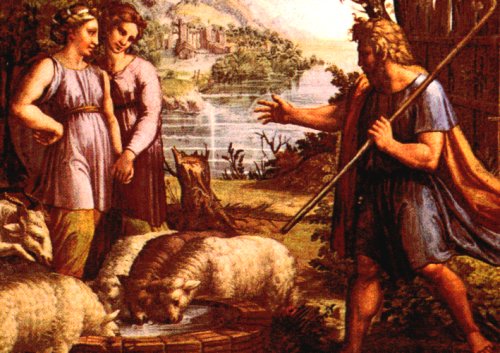 Good afternoon everyone!
Today's readings depict for us the story of Jacob's travels away from his homeland and to his uncle Laban's. So here are my thoughts for the day:
1) The dream at Bethel: Beth-el means "The House of God." Jacob calls it this because God revealed Himself to Jacob there. I'm reminded of the fact that this dream was primarily a way of reminding Jacob of what God is going to do for him and his family. But it is also a reminder that God does communicate with, and sometimes appear to and among His people, and their lives are changed because of their encounter.
Have you ever had a "Bethel" moment? Is there a "Bethel place" for you out there? For whatever reason, it seems that when God’s presence moves among people at a certain time or in a certain space, that time and place just stand out as sacred for us. They are life changing. They sustain us on our journey. And there is some sense in which that place or time becomes holy ground, which leaves us saying, “Surely the Lord is in this place and I knew it not.” Now granted, God is not only connected with certain spaces and times - but there are spaces and times which communicate to us, even long afterward, the awesomeness of God's presence in our lives, and the sureness of our faith in His existence and love.
2) The stairway to heaven - yes, it's literally a stairway. And no, the Bible didn't steal it from Led Zeppelin (that's a joke, by the way). It's interesting because Jesus makes a claim in the Gospel of John that they shall see the angels of God ascending and descending on the Son of Man - who is Jesus - and this is a reference back to the passage in Genesis 28. Jesus is the fulfillment of this prophecy, that all nations would be blessed through Jacob's descendants (Jesus is such a descendent). The interpretation of the passage in John is that Jesus is the bridge between heaven and earth - between God and humanity. Jesus reveals God's presence to us, and makes it available to us; likewise, he carries us to the heart of the Father. But, based on what Jacob has to say in response to this, and to Jesus' understanding later, the stairway communicates the ability to enter into the presence of God. And for Jacob, it was a sign that he was standing before the throne of the LORD Almighty and hearing the great promises of God to his descendants. Further, by being in the presence of God, Jacob's life was changed. The presence of God's power in our lives has the same impact - it changes us.
3) Jacob and Rachel: this story sets Jacob up as being almost as romantic as his father, until he kisses her and cries. haha. Sorry. Seriously, he was overcome by her beauty and the fact that he had found a person whom he truly loved. Anyway, when he goes back to Rachel's home with her, he promises to work seven years for Uncle Laban to gain her hand in marriage. He agrees, but then goes back on his promise, and tricks him to marrying Leah (which here seems equated with the act of sex - something to think about there). Leah has "weak eyes," which could mean she was blind, or unsightly, or even, as one rabbi put it, had cried so much that her eyelashes fell out because she didn't want to be married to Esau, which apparently the rabbi believes was pre-arranged (oldest of Laban for the oldest of Isaac; the youngest for the youngest). Whatever the case, she wasn't the one Jacob loved, but he was now "stuck" with her. But nevertheless, Jacob takes two wives (and I don't know why that's okay here and not elsewhere, but it is), and one's womb is opened; the other not. Then of course, he sleeps with their servants so that Rachel can have children (again I don't know why that's acceptable, but it is - and we saw how it worked out before). But finally, after eleven sons, the Lord God opens Rachel's womb and she gives birth to Joseph, who will be Jacob's prize child.
What do we learn from this? Well, we see what to avoid - treachery, having more than one sexual partner/wife, etc. Although these twelve tribes will give rise to the nation of Israel. Also interesting to note - Judah, the ancestor of Jesus, is the son of Jacob and Leah, not Jacob and Rachel. I find that really very interesting because the wife he truly loved was not the wife who would give rise to the promise of God. I don't know what bearing that has on us, but it's interesting.
And still... amidst the messiness of life, God is still working out His purposes. That's a life lesson to us if ever there was one. No one's life was ever what it should be, not even in the Bible. And yet God chooses to use the screwed up people of the world to accomplish His plans, and in the process makes them holy. The same is true for us - our lives can be pretty messed up, but God still uses us, God still transforms the messiness into good. And that's is the great hope and peace we find for our lives: God can still redeem us no matter how messed up we think our lives are.
That's a good note to end on... have a blessed evening!
In Christ,
Pastor Nathan
Saturday, January 9, 2010
Genesis 25:27-28:5
 Good morning, everyone!
In today's readings we continue to hear the story of Jacob and Esau.
When the boys grew up, not only were they rivals, but their parents also played favorites. It says that Esau was the hunter and the farmer, and his Isaac loved Esau because he was the “manly man.” But Jacob was the quieter, more introverted brother stayed indoors more often, and because of this Rebekah loved Jacob more. But let’s face it: in that day and age, it was better to be loved by the father because that child would be given the inheritance.
So Jacob had enough of being the underdog and he wanted to get his brother once and for all. He made it happen one day when Esau came in from the fields. Maybe it sounds weird, but I have this image in my mind of him looking like the Brawny paper towel guy with the mustache, the red hair, dressed in flannel with an axe. When he arrived, Jacob was cooking some stew. Esau was starving and he said, “Could I have some of that red stew?” Now was Jacob’s chance to shine, and if it was like a scene from my childhood, Jacob probably held up the steaming bowl right in front of Esau’s face, and says, “Mmm. Smells good doesn’t it. I’ll bet you want some.” And Esau said, “Uh, yeah, I want some. Give it to me.” “FINE.” Jacob said, “If you want it so bad, promise me your birthright.” Well, Esau, whose stomach was overpowering his brain, said, “What do I care about my birthright? I’m dying of starvation here – give me something to eat!” So Jacob gives him the soup, and Esau eats, drinks and goes away. That was not one of Esau’s finer moments. Esau may have had the bodacious body, but Jacob had the brains.
I suppose that one of the strange parts of this passage is that God condones Jacob's cunning attitude and trickery. But, on the other hand, Esau should have been responsible enough to know how valuable a birthright was in that time and place. To sell it for stew was rather irresponsible, and in my estimation, he therefore did not deserve to keep it. How often are we entrusted with gifts from God that we do not use? How often have we let our desires override our sense of responsibility? How might we be more responsible with and better stewards of our gifts?
Then there is a famine in the land. Although Isaac wishes to go to Egypt, God instead tells Isaac to simply sojourn through the land to the places where they can find food, for God will make his descendants as numerous as the stars, and this land will be given to his descendants forever. This is because God made the promise to his father Abraham. Notice again, God is keeping his covenant promises to his people, and rather than have them go to Egypt, he would prefer to keep them safe in the land he promised. How often are we doing what God desires of us, and feeling like we just don't have the support we need. Yet, if we continue to hold fast to God, and sojourn with Him, He will provide for us and guide us.
Then they have to pretend that Rebekah is Isaac's sister so the king will not take Rebekah away from him, but the king finds out one night when Isaac and Rebekah were laughing together. So I had never noticed this before: "laughing together” was a sign that they were married? I wonder if that's for real or just a euphemism - I don't know. Notice also that the king of the Philistines, Abimelech, is the king in the story who finds out and he’s not happy that Isaac lied to him. What’s funny is that this is the one of the same kings that Abraham had earlier tricked into thinking Sarah was Abraham’s sister and not his wife. I guess Abimelech didn’t learn to do background checks before summoning women to his private quarters the first time, did he?
Back to the birthright - apparently Isaac never knew about this birthright switch, and so there is the scene where Jacob pretends to be Esau. He receives the birthright and the blessing from Isaac, which again were both to be conferred upon the oldest child. One interesting passage is when Isaac asks how Jacob got the food so quickly, and he answers, "Because the LORD your God made it happen for me." It seems that God is at work in this situation even though it does seem tricky. It might seem like God is being unjust, but I think it also shows us that God does not always operate by the cultural norms of our day, or any day. The birthright thing is cultural, and not necessarily God's design. God desires to work through all of His children, and he often has other plans for us than what we have for ourselves, that others have for us, or that our society has for us. We can be truly fulfilled as humans when we seek to do what God will have us do, and to be content wherever God leads us, no matter what others might think or say. That doesn't mean we will always have a clear answer, or that human opinion plays no role (it does play a huge role - God does speak through us humans to one another), but it does mean that we should seek to do the will of God.
So Esau gets very angry and intends to kill Jacob once his father dies. Upon overhearing this, Rebekah warns Jacob and sends him off to her brother Laban for protection. Before he goes, Abraham orders him not to marry a Hittite, but to marry one of Laban's daughters - that is, one of Rebekah's nieces (i.e. his cousins). As weird as that is, the desire was to keep the lineage pure.
Well, this passage is all over the place. So I just thought I'd share some thoughts for the day. Have a great Saturday!
Friday, January 8, 2010
Genesis 25:1-26, 1 Chronicles 1:28-34
 Hi everyone,
This is round two for the day - just shy of 11:30PM! Oh well, we've done morning and evening today readings today, I guess.
There isn't a lot I want to comment on for these passages because most of them are genealogies. As I've said before, although they seem irrelevant, they are important for Jewish persons to see how they are physically a part of God's people as children of Abraham. Not only that, but for Christians, these display for us the fact that God is always faithful to His people from generation to generation, and that in the fullness of time, He would become one of us as a descendent of Abraham.
The main story we hear is that of Isaac and Rebekah's children Jacob and Esau. First of all, again we see another barren woman in the Bible. It does amaze me that the patriarchs and matriarchs of the Israelites all seem to be plagued by this problem. Rebekah had been married to Isaac for about twenty years, and she just could not conceive. Finally, Isaac prays to the Lord, and Rebekah conceives twins within her womb. Again, another lesson for those of us who need to learn how to trust our lives to hands of our faithful Savior.
Well, that’s when something odd happens: the children struggle with in her. In other words, those little boys start kickboxing each other inside her womb. Well, she’s confused by all this, and wonders, “"If I am having to deal with all this, why is this happening to me?" Literally, the text says she asked, “Why do I even go on living?” Well, she goes to God in prayer and asks what is happening. God tells her, “There are two nations are in your womb, two people groups butting heads while still in your body. One people will overpower the other, and the older will serve the younger.” Well, that’s odd. After all, in that society, the oldest son received the inheritance and was the prized child. And any of the other siblings would be forced to serve the oldest. As the oldest son, I rather like that idea. But God is in essence telling her, even before the children are born, that the youngest son would disrupt all this and take it away from the oldest.
So when they come out of the womb. Out comes one little baby, who was so red and hairy that it looked like he was wrapped in a blanket. So they named him Esau, which means “hairy.” But then as Esau was brought out of the womb, there was a tiny hand holding onto Esau’s ankle. As the next little boy was brought forth, he was named Jacob, which means, “ankle.”
So what do we glean from this lesson for today? Well, I'm not really sure. I think I'm still struck by God's faithfulness to His people, and to His plan to redeem those people - the same thing I keep pointing to. I'm also amazed at the ways God redeems and opens the wombs of those who are thought to be barren just so His plans can be accomplished. Nothing stands in the way of God's will.
I think as a follower of Jesus Christ, this should be a great comfort to us. When our lives are lived to the glory of God, and are centered in doing His will, nothing will be impossible for us. In fact, if God desires that we get a certain job, or marry a certain person, or have a certain number of children, or whatever else, then nothing will stop God from accomplishing His will for our lives. And we can take comfort in that, because if God is for us, and God is working for our best interests, then we can rely on the fact that He will remove whatever road-blocks lie in the way of accomplishing His will in us - and when the road-blocks don't move, that's because His will is that we go a different direction to get around them.
So in conclusion, I think there's much comfort for us in knowing that when our lives are lived according to God's desires for us, when we seek after Him with all our hearts, and when in prayer we seek to know that will, God will make even the impossible situations possible in order to accomplish His plan for us and in us. Friends, have a blessed night.
In Christ,
Pastor Nathan
Genesis 21:8-23:20
Good snowy morning to you all!
It's a bit cold and snowy here in PA. While the cold winds are howling around, the warmth of God's love calls us from the pages of Sacred Scripture.
1) Hagar and Ishmael - although it makes no real sense to us why this is the right thing to do, it's worth noting that God condones this action. Even when they are struggling in the desert, it seems like we should remain upset that Abraham listened to Sarah and cast the mother and son out of his life. And yet, God protected and blessed Ishmael, providing a well in the desert. Maybe there are times where God calls us to do difficult things or places us in situations where life makes little sense in the moment. In those moments, it is so vital to trust the guidance of God, who has the power to see the final outcome of the path to which he has called us.
 2) The Sacrifice (er... near-Sacrifice) of Isaac - this has always been a troublesome story for many Christians. Why would God ask Abraham to sacrifice his son? Does this an indictment against God's lovingkindness, that he would as a man to do this? It seems implied that God was doing this to test Abraham's faith - but the question is, why does God need to test Abraham's faith any more? The author of Hebrews in the New Testament believes that Abraham offered up his son, recognizing that God could raise even Isaac from the dead and even figuratively received Issac from the dead (Hebrews 11:17-19). Most Christians, therefore, see the story of Isaac as a "type" of Jesus Christ. That is to say, Isaac is representative of us, and how we should have to give up our own lives for the sins we've committed. The ram that God provides instead is symbolic of Jesus Christ, who gave up his life in our place at just the right time (Romans 5:6).
 3) Isaac and Rebekah - this is just a really neat story of how God works out His plan to bring a wife to Isaac. It's very romantic. Although I often hear the dangers in talking about finding a wife/husband as a part of God's plan for us, I do really think that God does often work like this, to bring the intimate love of another into our lives at the right time and in the right way. It doesn't mean that we should always wonder, "Is she/he the only one" when we do fall in love with someone, but rather that we should see our spouse as a gift to us from God. Further, I really love the way God makes everything work out perfectly. I also love how, when meditating and praying, Isaac's wife first appears to him, and he is comforted by her. It's just such a neat story, I think.
Well, that's yesterdays readings. I will post the readings for today later in the day. God bless!
Pastor Nathan
It's a bit cold and snowy here in PA. While the cold winds are howling around, the warmth of God's love calls us from the pages of Sacred Scripture.
1) Hagar and Ishmael - although it makes no real sense to us why this is the right thing to do, it's worth noting that God condones this action. Even when they are struggling in the desert, it seems like we should remain upset that Abraham listened to Sarah and cast the mother and son out of his life. And yet, God protected and blessed Ishmael, providing a well in the desert. Maybe there are times where God calls us to do difficult things or places us in situations where life makes little sense in the moment. In those moments, it is so vital to trust the guidance of God, who has the power to see the final outcome of the path to which he has called us.
2) The Sacrifice (er... near-Sacrifice) of Isaac - this has always been a troublesome story for many Christians. Why would God ask Abraham to sacrifice his son? Does this an indictment against God's lovingkindness, that he would as a man to do this? It seems implied that God was doing this to test Abraham's faith - but the question is, why does God need to test Abraham's faith any more? The author of Hebrews in the New Testament believes that Abraham offered up his son, recognizing that God could raise even Isaac from the dead and even figuratively received Issac from the dead (Hebrews 11:17-19). Most Christians, therefore, see the story of Isaac as a "type" of Jesus Christ. That is to say, Isaac is representative of us, and how we should have to give up our own lives for the sins we've committed. The ram that God provides instead is symbolic of Jesus Christ, who gave up his life in our place at just the right time (Romans 5:6).3) Isaac and Rebekah - this is just a really neat story of how God works out His plan to bring a wife to Isaac. It's very romantic. Although I often hear the dangers in talking about finding a wife/husband as a part of God's plan for us, I do really think that God does often work like this, to bring the intimate love of another into our lives at the right time and in the right way. It doesn't mean that we should always wonder, "Is she/he the only one" when we do fall in love with someone, but rather that we should see our spouse as a gift to us from God. Further, I really love the way God makes everything work out perfectly. I also love how, when meditating and praying, Isaac's wife first appears to him, and he is comforted by her. It's just such a neat story, I think. Well, that's yesterdays readings. I will post the readings for today later in the day. God bless!
Pastor Nathan
Thursday, January 7, 2010
No post today...
 Hi folks,
Well, I didn't have time to post today because it was a crazy day. I will do a double post tomorrow since I'm pretty sure I'm taking a snow day. Have a blessed evening and stay warm!
In Christ,
Pastor Nathan
Wednesday, January 6, 2010
Genesis 18:1-21:7

Good afternoon, everyone! I hope you are doing well on this celebration of the Feast of the Epiphany.
Today's readings put us in a very interesting part of the book of Genesis. Here are my thoughts for today:
1) "The LORD appeared... behold three men were standing opposite him." Is it just me, or does this seems to imply that the LORD appeared as three men? I don't want to read too much into the text, but that does have a Trinitarian ring to it. Again perhaps that is reading too much into the text, but it certainly sounds like this could be a hint at God's Triunity in the Old Testament.
1a) Notice also that Abraham's name is changed when God institutes the covenant of circumcision with him in Genesis 17. I missed noting this yesterday. Names are huge in this culture, for they told something about the person. Abram "Exalted father," becomes Abraham "Father of a Multitude."
2) Abraham's hospitality seems to be one of the major points in this chapter. Notice how well he attends to the strangers. This attitude of hospitality was (and still is) a major part of their culture. It is also something that is commended as a virtue in the Christian faith, especially considering Jesus taught us that when we do something for a brother or sister in need, so also we've done for him. In many ways, I find it sad that we've lost this virtue - perhaps because of the inherent selfishness and materialism of our generation. How could we recover a hospitality to the stranger in our lives or in our faith?
3) Sarah laughs. The three men/the Lord brought a message to Abraham that his wife would bear a son. Yesterday, God told Abraham this and he laughed at God. Now Sarah hears this news and she laughs at God. The big deal? He's 100 and she's 90. They're old. That's a big deal. It may seem that God is calling us to do something unconventional; nevertheless, "Is anything too difficult for the LORD?" No, in fact, "with God nothing is impossible" (Luke 1:37).
4) Sodom and Gommorah - not the place to be. A very wicked city. The messengers were sent to see if the place was really as bad as everyone said it was. It's destruction was indeed at hand, but the Lord states would spare it if even ten righteous persons were there. Notice then as we move into chapter 19 that it changes from three to two angels. I don't know what that's about. Nevertheless, Abraham's nephew Lot lived in Sodom, and when the messengers come upon him, he begs them to stay with him rather than in the square of the city. Again, notice the good hospitality.
5) So what was the sin of sodom? Was it sodomy? Well, if we're going to define sodomy as a sin, then it must be based on what is actually being considered a sin. What the men of the city want to do is to commit an act of rape. They want to violate the dignity of these messengers against their will. That is sodomy - a non-consentual act of homosexual rape. And by the way, the word "sodomy" is a 16th century invention; further, the word "homosexual" is a 19th century invention. Neither of these words appear in the original texts. I point that out not because I think the Bible supports the homosexual practice (because I cannot see how it does), but rather because of the way we've allowed our English translations to color our interpretation of the text in a way that prevents our understanding. The problem here is that this texts is used as a prooftext against homosexual practice generally by saying that Sodom was destroyed because they were, among other things, gay.
But that simply isn't the case; the sin of sodom is more complex than that. You see, what looms large all over this incident is the lack of hospitality shown by the people of Sodom, in contrast with the righteous hospitality of Lot and Abraham. The proposed act of homosexual gang-rape was only the icing on the cake and a symptom of a larger problem. This is Ezekiel's contention in Ezekiel 16:49-50, where the sin of sodom is named as being, "She and her daughters were arrogant, overfed and unconcerned; they did not help the poor and needy. They were proud and did detestable things before me." Consider Jude in the New Testament, who says that the men of Sodom went after "strange flesh." This probably has more to do with the fact that they wanted to sleep with angels, which was considered detestable elsewhere in Genesis.
Now I'm not saying anything about the moral quality of the homosexual practice at this juncture (so don't misread me); all I'm saying is that we have to read the original context and the biblical context, which makes the sin of Sodom out to be a great act of inhospitality, pride, arrogance, gluttony, and other detestable acts (including the gang-rape).
Also, Lot offers up his daughters - that's very troubling to me. I think the point of that was to show he was more willing to have the honor of his daughters violated than to have the honor of a stranger under his roof violated. This doesn't strike our culture well, but then again, perhaps we've gone so far the other direction that we would not even offer a stranger a place to stay with us. I'm not suggesting you give your daughters up to an over-sexed mob either, but I'm just saying, we really need to reconsider this passage well for our own lives.
6) Then of course the fire and brimstone come, and Lot and his wife are told to flee. Actually, they have to be drug out of the city - as if the Lord's vision wasn't enough warning! After being told specifically not to look back, she did and she turned into a pillar of salt. I read somewhere that one rabbi believes the word "she" refers back to "the city" and not Mrs. Lot had become a pillar of salt. I don't know how plausible that is, considering Jesus' command to "Remember Lot's wife." Why else would he say that unless something had happened to her. She becomes a reminder that once we've left our life of sin, we must never look back upon it; when we do, we will be enticed back into it and our lives destroyed because of it.
7) Then the whole thing with the daughters sleeping with Lot - that's just creepy and twisted. I don't know what that's about. But then again, this is how the Israelites described the origin of nations whom Israel despised. Whatever it is, it's pretty strange.
8) Isaac - the son is finally born. He is named Isaac, which means "she laughs." I find that pretty amusing. And God does the impossible - a 90-some year old woman gives birth to a child. Why do we question God so much in our lives? Why do we fail to trust Him? In the end, God is always faithful to His promises - sometimes we have to be patient long enough to see how.
I think that's enough for today. God bless!
- Pastor Nathan
Subscribe to:
Posts (Atom)