Saturday, February 27, 2010

Just a Quick Note...


Hey everyone,

So I hoped to post a little bit over the course of the last week, but preparation and completion of my finals has been tremendously more stressful than I planned. Anyway, I should be done by tomorrow night, so hopefully I will get us back on track with some updates pretty soon.

Till then, God bless and happy reading!

In Christ,
Pastor Nathan

Friday, February 19, 2010

Leviticus 4:1-9:25

Good morning, everyone!

Here is today's installment of our "Through the Bible in a Year" series.

1) The Sin Offering: Ironic this was a part of the reading for Ash Wednesday. On a day of solemn confession and repentance, we talk about the offerings that were made for unintentional sins against the LORD's commands. One thing to notice here is that the blood of a lamb was shed as an act of atonement (to atone is to "make amends"). In essence, sins were forgiven when life blood was shed. While it sounds gross and on some level horribly unfair, it's the system under which the Old Covenant operated. It's not that God has bloodlust, or that God is some sick freak. Sacrifice reminds us of how seriously our sin has separated us from God, and how severe are its consequences - it leads to death. Animal sacrifice is meant to make us squirm - because it reminds us of the serious consequences of sin. It's supposed to gross us out - because sin is supposed to gross us out.

The only unfortunate reality is that sacrifice does not have the power to change people's lives - only God's Spirit can do that. In time, God will say things like "I don't take delight in your sacrifices... what I really want is you to 'love mercy, do justly,and walk humbly with your God'" (Micah 6:8). Thus, in time, God will work to accomplish both in His people - through Jesus Christ, the Lamb of God. Through him, the amends-making offering is accomplished through His life of perfect obedience through His suffering and death.

2) Uncleanness - the whole idea of being unclean meant that a person had been defiled before God by something they did or something that happened to them. God typically gave ways for a person to be cleansed again, however.

3) The various offerings - I don't have much to say about these really. But the part where they have to change clothes through the various parts of handling the offering made me glad I am not an Aaronic priest.

4) Ordination of Aaron and the priests - I found this scene to be interesting, how they consecrated the people and how the dressed them for service.

5) The LORD sends fire to consume the offering and the people stood in amazement and awe, and bowed down before him. I find this scene to be very neat, as well.

We will contrast this scene, where the fire consumes the proper offering, with the scene where the fire consumes those who offer an improper offering in Leviticus 10. But that will have to wait until tomorrow.

Blessings in Christ!
Pastor Nathan

Tuesday, February 16, 2010

Numbers 7:1-89,Numbers 8-9:23; Leviticus 1-3:17

Hi everyone -

Wow, do we have a lot of stuff to cover today. Now we get into the fun parts of Torah. Hang in there - we'll get through it together!

1) "When Moses entered the Tent of Meeting to speak with the LORD, he heard the voice speaking to him from between the two cherubim above the atonement cover on the ark of the Testimony. And he spoke with him." This is on the ark of the covenant, which is like a giant, gold covered box. It had two poles, one on either side, so it could be carried. The lid had two cherubim (these six winged creatures from places like Isaiah 6 who surround the throne of God in heaven), whose wings covered the "mercy seat" in between, which signified the throne of God. It was here that blood would be sprinkled for the forgiveness of sins. God's voice then spoke from this place. It's as if at this Most Holy Place, heaven and earth touch each other - there is a portal into the supernatural, divine realm. I find this quite mysterious and awe inspiring.

Some questions for us to ponder are this: do we have places that symbolize such a connection for us? Why or why not? If so, where and what types of places? I believe that Christians have often shunned having places like these for connecting with the Lord. In part, this is because we see these laws and regulations as fulfilled in Christ, and we see them as

2) Setting apart the Levites... doesn't seem all that relevant, but notice how people are set aside (consecrated, made holy) for the service of God's people. The New Testament tells us that we are a royal priesthood, a holy nation... do we think of ourselves as consecrated to God's service? What would it mean for us to think of ourselves not just as "forgiven sinners" but also as "Holy people?"

3) People are unclean and cannot celebrate the Passover... yet Moses inquires of the Lord and they get special permission. This reminds me of situations I've faced in my pastoral career regarding the sacraments... something we call "Special Dispensation." haha.

4) The various offerings - I have nothing devotional to gain from these. But it is interesting to note the particular offerings made to God and what they signified.

Well, I know that's not much for as much Scripture as we've read... but that's all I have for today.

Take care and God bless.

In Christ,
Pastor Nathan

Sunday, February 14, 2010

Exodus 35:1-40:38

Good evening, everyone!

I apologize but I think until I get through the next week and a half, and finish my finals, these posts are going to be every couple of days. Nevertheless, we will continue our journey through Holy Scripture - my posts just may be a little further between.

1) Sabbath - we Christians live in a world where Sundays are no longer days of rest, but another day for business. But it is important to remember that the word "Sabbath" means rest. It is a day we set aside each week for rest, pleasure and worship of God. Not everyone can take the Sabbath on Sunday (which is the Christian Sabbath - the Jewish Sabbath described here was on Saturday). For instance, as a pastor, I have duties in worship and teaching on Sundays. So I must set aside another day for pleasure and rest (typically Saturdays at this point). But the point is still the same - the Sabbath is a gift from God, and we should set aside that day to honor Him, and to rest.

2) The Work of Buidling/Decorating the Tabernacle and its furnishings - I love this passage, weird as it sounds. I think that God's people should be given the opportunity to contribute to decorating the place of worship using their gifts and talents. Of course, these things were done in accordance with God's commands, and ours should be done in accordance with the rich traditions of the New Testament faith, and the succeeding generations. Still, I believe it neat that the people of God have the opportunity here to worship God by making furnishing and the like for the tabernacle. In fact, this was a really neat line in here too: "Then Moses called Bezalel and Oholiab and every skillful person in whom the LORD had put skill, everyone whose heart stirred him, to come to the work to perform it." The people's hearts were stirred to create ... creativity is a part of the image of God still visible within us humans. Of course, they end up with more than what they were commanded or needed, so they had to tell people to stop. But I just really like this passage because it encourages the creativity of God's people as a part of their worship of Him.

3) The tabernacle - you might call this a "temple on wheels." It was a sanctuary where the Lord's presence dwelled and where the people worshipped God. The point of it being on wheels was so that God's presence could continue to dwell with His people wherever they went.

4) The Glory of the Lord - the Lord descended on the tabernacle, His glory veiled by a cloud during the day and by fire at night. This is such a cool thing to think about. The movement of these signs determined where the people when and when they moved.

5) Why all these details? Well, it goes to show just how important proper worship was/is to God. Granted, the regulations for us Christians are not the same (considering that many of these practices are functions/actions now done by the Lord Jesus on our behalf, and no longer necessary for us to practice), still, I believe it is a reminder that worship is important to God, and something he desires we practice properly and in line with His will. It is not something we take lightly, but rather should be something we give proper consideration to.

Well, that's it for tonight. God bless!

In Christ,
Pastor Nathan

Exodus 35:1-40:38

Thursday, February 11, 2010

Exodus 28:1-34:35


Hi everyone,

Here is my latest "Thru the Bible in a Year" Post...

1) The vestments of the priests - again, attention to details in worship. These vestments are symbols of their office. In much the same way, my choice in vestments for worship (alb, stole, and occasionally the chasuble vs. the black Geneva-gown and stole) call attention to my place among other Christian ministers throughout history. Also, the deep symbolism of these vestments convey something of my position and calling (the stole is a symbol of the yoke of Christ, the alb a symbol of baptism, and the chasuble a symbol of putting charity above all virtues and the pursual of holiness - not to mention a symbol of willingness to die for the faith). To me, I don't get picky about what ministers wear in worship, but I have chosen to dress like this not out of formalism, but to deepen the symbolism of our worship service. Each of these vestments the priests wore were intricately designed and symbolized various parts of their function and service. Although I am not a priest, and do not function as one, I do appreciate this symbolism, and the symbolism of my own vestments.

2) Consecration of Priests - this was an all out barbeque - and I can't say I would mind to have this at my ordination. In all seriousness, I am glad we no longer offer sacrifices. But again it makes me think about the symbolism of our office as ministers and my own service of ordination.

3) Incense - I was told I could do just about anything in worship at Bessemer (within reason) EXCEPT burn incense. I had no intentions of doing so, but here we see an incense altar to be built. Incense is used to make a fragrant offering to the Lord, but it is also a symbol of the prayers of the people rising before the Lord (Psalm 141:2, Revelation 5:8, 8;3-4). I like incense (in moderation), and I like the symbolism of incense representing prayers offered in worship (in moderation), but I don't see other Presbyterians jumping on that bandwagon.

4) Anointing Oil - again, another image of consecration in worship. I think it interesting how much of these kinds of symbols were carried over into much of Christian tradition over the years (at least in Orthodox/Catholic/High Church Protestant sectors of the church).

5) The Golden Calf - The people forget about God and choose to give homage to a god of their own design, rather than the God who led them out of Egypt. I think so often we do this in our lives with so many things. Even some times in the church, our buildings, our music, our ways of doing things, our programs... can become idols. When we lose sight of the Triune God we serve, and turn to the idols we fashion for our own fulfillment, we commit idolatry.

Further, the people have a gigantastic bacchanalia (gorging on food and drink) and then apparently some sort of sexual escapade or "pagan revelry." Of course, this only adds fuel to the fire, because just after hearing of how the people are to keep themselves holy to the Lord, they give in to their passions and lusts, and defile themselves before the Lord.

6) The Lord's anger burned... and Moses abated it? That's what it seems to say. Folks will be quick to point out that this isn't what's really going on... because there is a need to defend God's actions. I really don't know if Moses really changed God's mind (which some say is impossible based on pre-concieved notions about God's character rather than looking to the text first), or if God "seemed" to change His mind; but whatever the case, God was still very angry. He sends the Levites to kill those who were unfaithful (about 3,000 of them), and then a plague comes upon them. Moses then has to go and make atonement for their sins. To say that God was unhappy would be an understatement. But why would God command such a killing as this? It's not a very loving answer - but it seems like this is meant to say to the people of God that God is a jealous God, who created us to worship him, and when we turn to idols, we cast off God. When we cast off God, we separate ourselves from God and thus from His presence forever. So by killing these people, it was a sign of the death they will face. But who knows, I could be wrong... I've not researched this answer.

7) Aaron makes an excuse - "I swear, all I did was throw this gold into the fire and ... poof... out comes a cow! I dunno!" But clearly Moses knew better. How often do we try to justify our sinfulness before God and others? How often do we make excuses for why we did or did not do something for God or others?

8) The Glory of the Lord - Moses then asks God to reconsider his decision to depart from His people for fear He should wipe them all out. Then God says that he will not depart from them, for God has called them to be His people. Moses then wants to see the glory and goodness of the LORD. And the LORD said, "I will cause all my goodness to pass in front of you, and I will proclaim my name, the LORD, in your presence. I will have mercy on whom I will have mercy, and I will have compassion on whom I will have compassion. But," he said, "you cannot see my face, for no one may see me and live." So God hides Moses in the cleft of the rock as the Lord passes by. I like this scene

9) When the LORD passes, the LORD proclaimed, "The LORD, the LORD, the compassionate and gracious God, slow to anger, abounding in love and faithfulness, maintaining love to thousands, and forgiving wickedness, rebellion and sin. Yet he does not leave the guilty unpunished; he punishes the children and their children for the sin of the fathers to the third and fourth generation."

10) God calls the people back into covenant, forgives them, and once again calls them to live holy lives as a holy people before the Lord.

11) Moses' radiant face - from seeing the glory of the Lord, Moses' face shown so bright that his face was veiled because it was blinding people. I wonder, does the Lord's presence in our lives by the power of the Holy Spirit shine through our lives and in our faces, so that others see His glory in us? If not brightly, even faintly? This is something to ponder as we consider our relationship with God and the way we live our lives.

Well, that's all for tonight - God bless!

In Christ,
Nathan

Tuesday, February 9, 2010

Exodus 22:16-28:43

Hi everyone,

Well, I don't have a ton to say about the last two days worth of readings, because they're... well, lots of laws and regulations. So here are just a few thoughts...

1) Again, keep in mind that these laws are meant to provide guidelines for the people to live in covenant faithfulness to God. They help us today to understand just how powerless we are to keep all these laws, and thus live in accordance with God's character.

2) All the furnishings of the temple - You're thinking, "Is this really necessary?" Well, it was. It was a sign to Israel just how important worship is to God, and that we do it in a way that honors Him. This is something to which we must always give great consideration. And notice the consideration given to art, do decoration, and to furnishings. All these things do matter in our worship.

If you have any thoughts or insights on the text, don't hesitate to leave a comment.

In Christ,
Pastor Nathan

Monday, February 8, 2010

Exodus 16:1- 22:15

Hi everyone,

Here is the latest installment of our journey through the Bible.

1) The people start to grumble... I'll never forget telling some group at church that the people of God in all ages always seem to be the most blessed in terms of spiritual blessings bestowed.. and yet, for whatever reason, they are always so prone to grumbling and complaining! But here again, we see that God continues to provide his people with gifts for their survival, and yet the complain that it's not enough. They even wish they had been back in Egypt rather than wandering around in the desert to die!

So God sends them quail to eat at night and manna during the day. You may be asking "What is manna?" Well, funny you should say that, because that's what manna means: "What is it?!" It is interesting that the word used is of Arabic origin, meaning "plant lice," which could also refer to the modern scholarly theory that manna is actually "honeydew" produced when insects eat certain vegetation. There are some other theories about this, but whatever the case, God provides these people with food that looks like a coriander seed and tastes like honey wafers.

2) All is well, but now the people are thirsty... "Give us water!" Moses says, "Why are you complaining to me? Why do you put God to the test?" Then he calls to God ask for help, asking, essentially, "Why did you stick me with these people? They're about ready to stone me!" If you're a pastor, or you've spent enough time working in/with a church, this scene should make you chuckle because of its sheer familiarity.

3) The scene with Moses' arms raised... that makes me chuckle. When they got tired, they propped a stone underneath his arms. haha... it's the original "Touchdown Moses."

4) The Jethro scene... this is an interesting story about how Moses was overworked as the mediator between God and humans. So Jethro suggests that Moses teach the people the laws, and that he appoint judges to be mediators for the people. It is a lesson to me about making sure that I divide up the work of God among other capable people, so that their gifts may be best used to glorify Him and that His people might be edified.

5) The Lord is coming... down among the people to consecrate them as His people, that is. He has come to make them a "royal priesthood, a holy nation" through their observance of His covenant. The purpose here is crucial to understand: if Israel will obey the Lord's commands and observe His covenant, they will be a light to the nations. They will be a holy priesthood, through whom the whole world will have access again to God. In essence, what we Christians believe Jesus did for us in gaining access to the Father, is exactly what God wanted Israel to be for the nations. Although they often failed at living up to this, God finally fulfilled it through Jesus Christ, their descendent, who is declared to be the Son of David and the Son of God.

6) So they must prepare themselves for the occasion - do the laundry, etc. What's funny is that Moses adds something (or so it seems) to the list of things to abstain from: "sexual relations" (or "going near a woman"). I find it interesting that this is the case, as sex between a married couple would not be something I (or many other Christians) consider dirty. I'm still not saying it is - but it is interesting that this passage would have us believe that it would prevent us from entering God's presence with a clear conscience.

7) Also, it's interesting to me that the period of consecration is three days... God seems to like the number three a lot. When God does appear, notice how he shows up... A great cloud, thunder and lightning, the trumpet blast, a ton of smoke, and the Lord descended with fire. This is really quite an image of the power and majesty of God. We don't often think of God in this way, but as much as God is loving and relational, God is also a powerful God who rides on the winds of the storm (Nahum 1:3). It's also important to note what the Book of Hebrews says about this image (Hebrews 12:18 and following), contrasting it with the new reality is that is in Christ. So I believe that God is to be revered and worshipped, but is not someone of whom we who have been called should be "afraid." God is powerful, but God is loving, and in Christ, we have been saved from His wrath so as to stand in the majesty of His presence without fear, but with reverence, respect, and filled with awe.

8) The point of the Ten Commandments and the laws ... I don't know if I believe that these laws were ever meant to be Israel's salvation. I tend to believe heavily that the laws of God were meant to reveal what God's righteous character looked like, to reveal to Israel their dependence upon God for their salvation, to rightly order their lives as a covenant community and nation, and finally that these are guidelines for a proper relationship with God. All of these ten sum up the whole law: the first four are about our relationship with God, the last six are about our relationships with others. In the Reformed/Presbyterian tradition, our confessions will take each of these commandments and expands them, helping us see what they forbid and giving us a positive way of living in light of them. I at times disagree with the writers in the past assumed were sins forbidden based on these commands (i.e. the treatment of music and art based on the second commandment, the regulative principle of worship, etc.)

9) Then God sends the fire and thunder and lightning again... and the people are scared. They ask Moses to stop God from speaking to them. Moses says, "Do not be afraid. God has come to test you, so that the fear of God will be with you to keep you from sinning." I really need to ponder the point of all this - why are the people so afraid of God and Moses is calm, cool and collected?

10) Then God starts to declare to the people his laws... and notice how many things result in death! These are most definitely the civil implications for the nation, and not punishments that would carry over to this day. For instance, "But if there is serious injury, you are to take life for life, eye for eye, tooth for tooth, hand for hand, foot for foot, burn for burn, wound for wound, bruise for bruise." But Jesus will contrast this in Matthew 5:38-40, where He says, "But I tell you, do not resist and evil person. If he strikes you on the cheek, turn to him your other also." I remain convicted that God calls us to refrain from violence against one another based on Jesus' saying in the Gospel. Again, these laws seem very harsh at times, but as Christians, we must focus on the general principles we see displayed here. As we will see in time, not all of these laws carry over into the New Testament based on what the NT writers and Jesus say to us about them. And as Christians, we see the Old Testament (in terms of application) through the eyes of the New Testament. But we will turn to this in time...

Well, that's all for today. Hope it is a good one!

In Christ,
Pastor Nathan

Friday, February 5, 2010

Exodus 12:1- 15:27


Hi all,

Wow, it's a snowy night in PA with like 7 inches or more on the ground. Anyway, in the warmth of my house, I am sitting down to do my pastoral tasks for the night... so here we go.

1) The Passover Scene: The blood on the doorpost was a sign for the Angel of Death to "Pass over" the houses of the faithful Israelites. There is a great deal here that describes this ancient tradition and I encourage you to read this slowly and contemplate what is happening and the tradition established for the people of Israel. Although Christians do not generally observe the Passover as such, they do tend to celebrate Holy Week around the same time, since Jesus was crucified around the time of the Passover. They eat the sacred Eucharist, which was first celebrated during the Passover meal on Maundy Thursday. Yet, theologically, there is drawn a connection between this event and the events of Jesus' death and resurrection; there is a connection between the death of Christ (the Lamb of God), whose blood was shed, and the ancient passover practice. The Easter Vigil service always includes the story of the Passover as one of the readings, showing that just as all these events happened, this pointed forward to the time when the blood of Christ would save His people from death, deliver them from bondage to sin, and lead them through the waters of judgment to new life. The ancient hymn used at this service, the Exultet, says of this:
"This is our passover feast, when Christ, the true Lamb, is slain, whose blood consecrates the homes of all believers. This is the night when first you saved our fathers: you freed the people of Israel from their slavery and led them dry-shod through the sea. This is the night when the pillar of fire destroyed the darkness of sin! This is the night when Christians everywhere, washed clean of sin and freed from all defilement are restored to grace and grow together in holiness. This is the night when Jesus Christ broke the chains of death and rose triumphant from the grave."


2) Pillar of Cloud by Day ... Pillar of Fire by night - I really love this symbolism. When we use the Paschal candle in worship, it signifies that our Lord is a pillar of fire who leads us from death to resurrection. This passage is, in part, the place from which we draw this symbolism. I think it is just a neat image of our God, the all consuming fire, leading his people along in procession into the Promised Land.

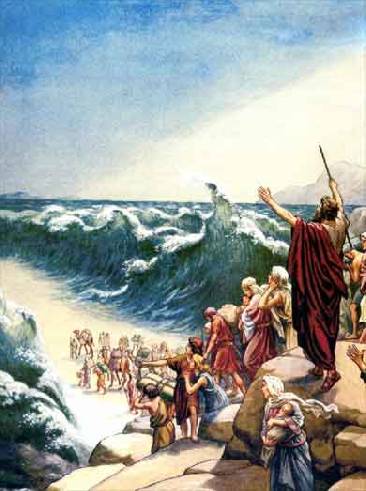
3) The People Are Led Across the Sea on Dry Land - from the old life into the new. From slavery to freedom. All by the hand of God's grace. It is a type picked up in the New Testament, for sure, of the life we now live in Jesus Christ.

4) But... the people complain! Haha, what else is new. Even in the midst of their promised deliverance, they look back and are afraid of Pharaoh's army! Yet, all the while God is leading them along. How often do we, surrounded by blessings and God's presence/calling in our lives, shrink back in fear at the sight of what seems to weigh heavy against us?

5) The Song of Miriam and Moses - When the people of Israel had been delivered, they sang to God in praise. I love this particular scene in the "Prince of Egypt," when the children and all the people sing in Hebrew: " I will sing to the lord for he has triumphed gloriously, I will sing to the lord for he has triumphed gloriously! Who is like You, oh Lord, among the heavens? Who is like You, majestic in holiness? In Your Love, You lead the people You redeemed, In Your Love, You lead the people You redeemed!" (you can find that clip here). Although we may have found some of the things we've read this far puzzling, strange and even troubling, what amazes me is that God is bringing about His purposes, delivering His people from oppression and bondage to a place of freedom to serve Him. I'm amazed that even when God's people are enslaved to powers and principalities of evil, and under the oppression of tyranny, even in bondage to sin, God works to deliver his people and to lead them back to the Promised Land by His presence. And this He does even in our own lives through Jesus Christ!

By the greatness of Your arm they are motionless as stone; until Your people pass over, O LORD, Until the people pass over whom You have purchased. You will bring them and plant them in the mountain of Your inheritance, The place, O LORD, which You have made for Your dwelling, the sanctuary, O Lord, which Your hands have established. The LORD shall reign forever and ever.


Have a great evening!

In Christ,
Pastor Nathan

Thursday, February 4, 2010

Exodus 5:1-11:10

Hi everyone,

Wow, I'm getting bad at updating this, but I will try to summarize some thoughts over these eight chapters.

1) Impatience with God's plans: Moses says, "O Lord, why have you brought trouble upon this people? Is this why you sent me? Ever since I went to Pharaoh to speak in your name, he has brought trouble upon this people, and you have not rescued your people at all." But God assures Moses that he has not ignored his people or forgtten them, "I have heard the groaning of the Israelites, whom the Egyptians are enslaving, and I have remembered my covenant...'I am the LORD, and I will bring you out from under the yoke of the Egyptians. I will free you from being slaves to them, and I will redeem you with an outstretched arm and with mighty acts of judgment. I will take you as my own people, and I will be your God. Then you will know that I am the LORD your God, who brought you out from under the yoke of the Egyptians. And I will bring you to the land I swore with uplifted hand to give to Abraham, to Isaac and to Jacob. I will give it to you as a possession. I am the LORD.'" However, when Moses went to tell this Israelites this, they said, "they did not listen to him because of their discouragement and cruel bondage."

Frequently, it seems as though what we pray for does not come to fruition in a timely manner. It seems like we're called to do something and, rather than keep with it, we get frustrated and want to quit. But we must remember that God's timing is often better than our own, and even here, God accomplishes his goals in his time. Thus, we must remember to endure patiently, knowing that if we do so, God will bring about His will in His time.

2) "Betcha know me now!" Gotta love the stories of the plauges. By the time they get to the gnats, the officials of Pharaoh are convinced that these are coming by the finger of God. Pharaoh remains unchallenged. Then there's the scene with the flies, where Pharaoh cries "uncle" and lets the Israelites go into the desert to offer sacrifices, and the flies stop. When that happens, he says, "suckers!" and refuses them yet again.

Then before the hailstorm, God says, "For by now I could have stretched out my hand and struck you and your people with a plague that would have wiped you off the earth. But I have raised you up for this very purpose, that I might show you my power and that my name might be proclaimed in all the earth." Again the language of both God's patient endurance (He could have wiped them out), but also God's purposes in raising up Pharaoh so that God's name might be proclaimed throughout the earth.

But once the hail comes, Pharaoh cries uncle again. He lets Moses get out of the city, but once the hail and storm stop, he changes his mind and brings them back inside. Then the locusts come, and this time, the officials say "Don't you realize Pharaoh, that if we don't let these people go, all Egypt will be destroyed?!" So Pharaoh tries to make compromise, but the locusts come anyway. Cue repentance and end of plague. But then God hardens pharaoh's heart again, and he still doesn't let them go. Then God sends the darkness upon him. Same thing. This time, Pharaoh says to Moses, "Get out of my sight and the next time you see me, you will die."

Of course, that is not the end. God has one more plague in store - the death of the firstborn son. So God speaks this through Moses, and Moses leaves Pharaoh's chamber hot with anger. God says, "Pharaoh will refuse to listen to you — so that my wonders may be multiplied in Egypt." I don't mean to sound like an ungrateful person, but why did God need to do this to demonstrate his power? Had he not already done enough to display His power?

Here's the thing. Before God had ever hardened Pharaoh's heart, it was already hard. He new not Joseph - that is to say, he also knew not the LORD God. He then went and committed an act of infanticide against the Israelite people because they were overpopulating the place. What it seems to me, then, is that God is displaying his power against a tyrant who enslaved his people. When God hardened his heart, he just intensified Pharaoh's feelings.

Ross Taylor gives further insight into the matter on his website (http://www.apocalipsis.org/difficulties/Pharaoh.htm). He says there are several things to note (in summary):

a) God had told Abraham 400 years earlier that his descendants would be mistreated and that God would punish the nation they served. God told Moses beforehand that he would harden Pharaoh's heart.

b) The Egyptians were oppressing God's people with harsh slavery, Pharaoh ordered the slaughter of newborn males. God heard the cry of his people and it was time to act to release them from bondage.

c) Pharaoh was given numerous opportunities to change his mind and let the Israelites go. He was given signs even before the plagues had begun. He was stubborn and hardened his heart, and he was deceitful in his dealings with Moses. He repeatedly said that some of the Israelites could go, only to change his mind, once the plague had stopped.

d) Many of the plagues were conditional and were of increasing serverity, if Pharaoh had humbled himself and let the people go the plagues would not have happened, including the last and most dreadful in which the first-born male Egyptians died (eldest sons).

e) After Pharaoh had seen the evidence of the miracles of the first five plagues, which had convinced his own advisors, he continued to harden his heart, he refused to humble himself before the true God. Only after the sixth plague did God give what Pharaoh had chosen, and he hardened Pharaoh's heart, so that he would not let God's people go.

f) After that God proceeded with more plagues, and finally Pharaoh let them go. Even then he changed his mind and pursued them to the sea. One further miracle was required, the parting of the Red Sea so that the Israelites could escape the pursuing Egyptian armies and the destruction of Pharaoh and his army as they pursued the Israelites into the sea.

g) The final result was that God's power and glory were demonstrated to the Egyptians and his people. The Israelites were delivered from slavery in Egypt and they now believed that God was Lord (Jehovah) and trusted his servant Moses. God's name was spread throughout the world. Egypt was punished and her god's judged.

h) Although God knew that Pharaoh would harden his heart, he was more than fair with Pharaoh. Only after Pharaoh ignored the evidence of the miracles and the advice of his own advisors, and had repeatedly acted stubbornly and deceitfully did God give him over to his own desires and harden his heart and then judge him.

i) God does not delight in the death of the wicked, he sent his Son to die for our sins, God has made it possible for us to enter heaven and to enjoy him forever."

Well, anyway, I think in my next post, I will talk more about the Passover scene, rather than tack it on to todays readings. Again, sorry I've gotten behind - I should now be almost caught up on things. Have a great night!

In Christ,
Pastor Nathan

Wednesday, February 3, 2010

Exodus 1-2:25; 1 Chronicles 6:1-3; Exodus 3:1-4:29 (Updated)

(Note - I added to the hardening of Pharoah's heart section because I put something totally strange there - I apologize - I was falling asleep as I was writing last night and just wanted to get done. I've added some new info down there for consideration).

Hi everyone,

Well, I thought I would just post a few thoughts on the readings for the last few days before bed. So here we go...

1) God thwarts the plans of the wicked Pharoah when he asks the midwives to kill the Hebrew boys. Moses, we find, escapes Pharoah's wrath on a couple of occasions as well by the hand of God. It just amazes me how God continues to protect His people while they are working out his purposes, and in the process thwarts the plans of the wicked.

2) The burning bush - this is a perennial symbol for Christians of God's calling upon our lives, and his revelation of himself to us. I think it interesting that God's name is introduced to us: "I AM" or "I WILL BE" The Hebrew is YHWH, which is usually pronounced "Yahweh." Yet because the Jewish people are afraid to misuse the Name of the Lord, they choose to call Him Adonai (which means "Lord") when this word appears in the Scriptures. God also promises to bring the Israelites back to the land God promised Abraham, Isaac and Jacob.

3) But Moses said, "O Lord, please send someone else to do it." Then the LORD's anger burned against Moses... I think Moses speaks as we might if God showed up to us and called us to lead His people from slavery. We too might ask if God couldn't just choose someone else. But that is not what God wants - God wants us to do His work as he has called us. And he equips us with the strength, the capabilities and the timing to accomplish that wil.

4) Hardens Pharoah's heart - I said last night "Boy, God just has to make this difficult!" He did - because this is a very complex statement. It seems hard to believe, on one hand, that God would harden a man's heart (and thus, presumably, lead him to sin against God). But, as the text indicates, this is what God did. Further, in Romans 9:17-18 says, "For the Scripture says to Pharaoh, 'For this very purpose I raised you up, to demonstrate My power in you, and that My name might be proclaimed throughout the whole earth." So then He has mercy on whom He desires, and He hardens whom He desires.' " In other words, what Pharaoh did was by the will of God so that God's Name might be glorified. That seems totally strange to me. Some scholars state that what God did to Pharaoh was to simply intensify Pharaoh's natural inclination away from God (which makes more sense to me), while others argue that God actively, and directly, hardened Pharaoh's heart. I don't think the Christian faith rises and falls on this (per say), but again, it does lead us to wonder why God would cause someone to sin against Him. Again the purpose is to bring glory to God in all this, but I'm not sure how Pharaoh could actually do the will of God in either situation. I don't know the answer, so, needless to say, this is a difficult passage for sure.

5) The circumcision thing: God apparently wanted to kill Moses. Why, you ask, when He just chose Him to lead His people? Well, because circumcision was commanded of God's covenant people, and because those who are uncircumcised are to be "cut off" from their people (what a pun!), Moses' son would have been outside the covenant. And that would not be a good thing. So, Zipporah, his wife, does the circumcision and throws the foreskin at his feet in disgust. I don't know what to say more about this except that sometimes when we seek to live within God's covenant, it creates a messy situation, and it's not always pleasing to everyone.

Well, that's all for now. Have a great night!

In Christ,
Pastor Nathan

Tuesday, February 2, 2010

Addendum to Yesterday's Post

Well, in the light of day, yesterdays summation of what happened actually made coherent sense. Kudos to me who was drifting in and out of consciousness, wrought with fatigue while writing.

Anyway ... I still have a little more to say because in the past couple of weeks, I've really wrestled with this question.

First, evil is a real force in the world. Evil is what incites people to wreck havoc on others. And while God could stop it (and I'm not sure why He does not already), often he just lets it happen. Sometimes evil attacks a person's body, riddling it with disease, or a person's mind, driving them into despair and depression. Evil is a force in this world that still exists, and still torments us. Evil (via the Satan/the Adversary) is what caused Job's problems).

The question, then, is why does God allow evil to continually have power? After all, if Jesus' death and resurrection are the acts which conquer the forces of death and evil, should that not bring an end to their tyrrany? Well, yes and no. Evil and death will meet their end when Christ comes again to judge the world, and to establilsh His eternal rule in glory (Rev. 20). In the mean time, God has basically put a limit on their power - that is to say, they cannot finally destroy us in terms of our eternality. Although hard to understand, the Bible speaks of the fact that God has delayed Jesus' return for the purpose of our salvation, meaning in my opinion that it will not come until God has gathered His children back to Himself (2 Peter 3:15).

Now that may not fly with some, and that's fine - it's probably not a fully adequate answer. I guess I still feel the need to defend God - and then again I don't. God is, as we say "a big boy" (a very omnipotent one at that), and He really doesn't need me to defend his ways. If there are those who wish to either question His existence or reject Him based on what they believe is unjust suffering, that is their perrogative and their right. Faith is not faith if a gun is held to one's head until they submit to it. But faith is neither blind or ignorant - often it is a way of making sense of a person's experience of God, and the shared experiences of many people. More than that, we hold that the content of our Christian faith is something passed down to us from those who were eyewitnesses to the acts which won our salvation (2 Peter 1:16-21).

But that doesn't abate the feelings of hurt and suffering that people face, and the lack of trust that insights toward God. That's fair too, I suppose. But I want to suggest (as someone young who admittedly has not experienced a great deal of suffering or pain in my own life - but has experienced a time of great doubt and a sense of God's absense in my life) that sometimes, the only thing we can do is to do something like what Job did - wrestle with God, be angry at God, question God - but never really loose our faith in Him. Trust in the face of doubt - hang on to God in the hopes that someday, we will trust and praise Him again with joy, and experience His presence again (Psalm 42).

This reminds me a little of St. John of the Cross, and his Dark Night of the Soul. If I recall correctly, the "Dark Night of the Soul" is when we feel God's absense, as well as the absense of joy and spiritual fulfillment. We find that prayer, worship, meditation, etc. do not hold spiritually fulfilling to us. It seems like God is absent from us. This can lead us into a time of great despair and doubt, without actually rejecting our faith. Yet this process is one which actually is a part of our journey from the world to union with Christ (which is the goal of Christian life - will explain another time). Yet many of the mystics who talk of this (and those persons who have experienced it) know that the goal of such moments (when we truly experience them) is to deepen our faith in and love of God. It allows us to be stripped of the sensation of the spiritual rewards of our faithfulness to God (peace, joy, etc), and begin to practice our faith purely out of selfless love toward God (not seeking the emotions it brings, but seeking God's being, Himself, alone). And in doing that, we learn to love God above all else, and see that whatever comes to us on earth is nothing compared to the glory yet to be revealed (Romans 8).

I think this is hard to imagine on some level - because we associate love with the feelings we get; and when the feeling we get disappears, "the love is gone." But love is not a feeling; love is action - more than that, love is a Person (1 John 4:16). When we look at Jesus, he gave up everything because of His love for the Father and His love for humans like you and me. When we love God, we too are called to abandon everything and follow Him - or maybe better put, consider everything rubiish in comparison to the surpassing greatnest of knowing Jesus Christ (Philippians 3:8). I think with Job, we see how Job had everything taken away from him, and although he wrestled with God and got very angry with God, he never lost His trust in God. And I hope (although I don't know for sure) that what the end of chapter 42 indicates is that Job learned to love God above all else in a more deep way, and that in the end, Job found out that all he really needed was God. Maybe in the midst of our own suffering, instead of letting the question "Why?" plague our minds, we view suffering as an opportunity to strip ourselves of everything that we think matters to us, and truly cling to that which really matters - the Almighty and loving God who created us and never lets us go.

Maybe that's reading into it. But I find it unnerving when people just assume that Job followed God because God forced Him to or left Him without an answer. "God's just a miserable tyrant" they assume. But could it be that because Job still trusted God, and while God didn't reveal His actions, in the face of overwhelming evidence for His power and providence, Job simply knew there was no reason to question God's justice? In the end, God is who God is, and God does what God promises to do (the New Testament never promises that bad things will not befall us when we come to faith, or that life will always be fair, by the way - I would say the same is true for the Old Testament, but am always willing to be proven otherwise). Could we just find a way to accept that we don't understand God, and while it may seem unfair, maybe I just don't understand what's really happening when I suffer? Could we just say, "God, I trust you anyway because I see your love in Your selfless suffering, death and resurrection for my sake. I am hurting and broken, and my trust is hurth, but I will continue to trust in your promise that whatever is going on, you're going to work for the good somehow. And I'm going to trust that whatever I experience now pales in comparison to the glory and the gift of my eternal home that you promise." To me that's true faith - trusting God even when it's hard and doesn't make sense. Some who are more cynical may call it idiocy - but then who ever said faith was completely rational?

Well, I've rambled on. I don't know if that makes sense, but that's just what I do with all this stuff. Although God seems unjust in this book and in life at times, we have to recognize that if we're going to get mad at God, that doesn't change the fact that He exists. It also doesn't change the fact that God's ways are higher than mine. His knowledge and His love are more infinite than mine. So I admit that I, like Job, don't really understand, and I just submit to God. Call me weak, call me stupid - but that's the only thing I feel I can do. To reject the God who has encountered me in Jesus Christ by the power of the Holy Spirit, to reject that which gives strength to me and enables me to not only love others and work for good in the world, but to get up every day, to reject the claim Jesus has on my life that I believe will keep me in eternal life would be about the most foolish thing I could do. Why would I throw all that away because I can't fully grasp the magnitude of it, or even some aspect of it? The power of what God promises to do in the midst of and through our suffering seems to make up for the lack of understanding I have about what role God plays in its cause and the threat it may or may not have against His justice.

So it goes. Here I stand, I can do no other. God help me. Amen." Criticize, comment and whatever else.

Hope you have a blessed day!

In Christ,
Pastor Nathan

P.S. I will get to the Exodus readings later... I have to work on my PIF (Resume) first.

Monday, February 1, 2010

Job 38:1-42:17

They say the road to hell is paved with good intentions. I believe it.

Anyway, I will go ahead and give a wrap-up to Job, and we'll move into Exodus tomorrow. I'm having a busy week, so please bear with me.

God shows up out of the great storm, and he basically gets angry with Job for presuming that he knew better than God what was just, right and fair. God runs the laundry list of the thing He has done, and asks Job if he has the power to do these things. The point is that God is reminding Job in the midst of all this that Job is not God, and he does not have the power or the knowledge of God. God alone knows the fullness of his purposes, and humankind is unable to understand these things fully.

This Job realizes when he says, "Surely I spoke of things I did not understand, things too wonderful for me to know." Job, upon encountering God's divine presence, recognizes that when he questioned God's justice, he was questioning that which he did not know. And so he repents. With that, we find that God's testing of Job ended, and he received back twice what he had before.

Now I've noticed over the past few days that if you search the internet about this book, there are a ton of people who are angry about this story, who feel for Job, and have left the Christian faith altogether because they cannot understand why a loving God would do this to Job. And there is a part of me that does wonder, in the face of suffering, what God is really up to in all this. I don't understand, and God certainly doesn't look to good in the beginning of this story, wagering a bet with the Satan over Job's allegiance.

I discussed this topic the other night with my youth group, and I will say the same thing that I said to them. When it comes to the question of human suffering, and why God allows it to happen, my answer is, "I don't really know - except to say that this is the way life is. " Although we see these strange scenes at the beginning, I really can't say for sure in every situation that I know exactly what God is doing. But what I do know is that we can learn a few things from Job's story:

1) Job never cursed God - i.e. Job never rejected God. Sure Job was mad at God, sure Job accused God of wrongdoing, sure Job wanted to talk it out with God. But Job never denied God's existence, and He never rejected God.

2) God never really left or ignored Job - although Job was inflicted by Satan with all kinds of problems, God still shows up to have a chat with him. And in the end, after Job realizes the lack of wisdom he displayed in all his complaints against God, that in the end God knows what he's doing. (Although some assert that he says this only because God forced him into it, I think that if Job were really unconvinced by God, I don't think he'd have kept serving God after some time).

And a few Christian thoughts from outside the book:

1) Not all suffering is meaningless: often God uses it to strengthen us and enable us to grow. That may sound strange, but that seems to be, in part at least, what is happening here. (James 1, Romans 8)

2) God is not unfamiliar with suffering - Jesus as God in human flesh, endured the whole spectrum of human suffering. The author of Hebrews tells us that because he became like us, Jesus can sympathize with us in our weakness. Not only that, but he provides His Holy Spirit to comfort us in our trials.

3) It is in God's nature to turn the bad into good - the promise Paul makes in Romans 8:28 is that God works for the good of those who love him and are called according to his purpose. Further, if God is for us, who could be against us. The point is that whether or not we understand what God is really doing behind the scenes of history, we do understand that there is nothing we face that God will not finally turn into good. That's kinda what happens to Job (except he doesn't get back the sons and daughters who were killed.

I'm not sure that I'm making coherent sense anymore, so it's time for bed. This may not be a complete thought on the matter, but I think it will have to suffice for now. Good night!

In Christ,
Pastor Nathan